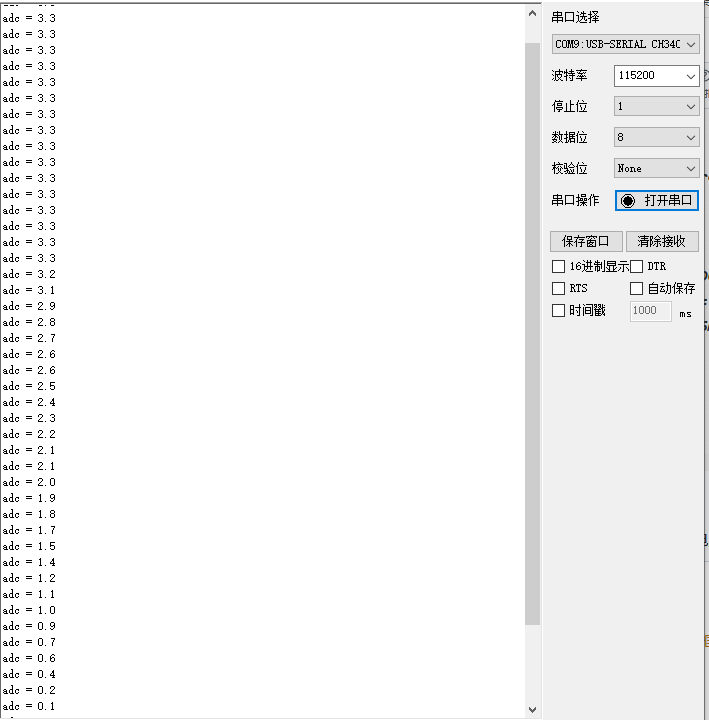
测试开发板ADC功能。通过电位器外接3.3V电源电压,调整ADC的电压输入,通过串口打印输出ADC采集的电压值。
一、硬件部分
1.1、ADC测试引脚
测试使用P004引脚作为ADC的输入引脚,电位器分压后,输入到P004。

1.2、硬件连接

二、配置ADC
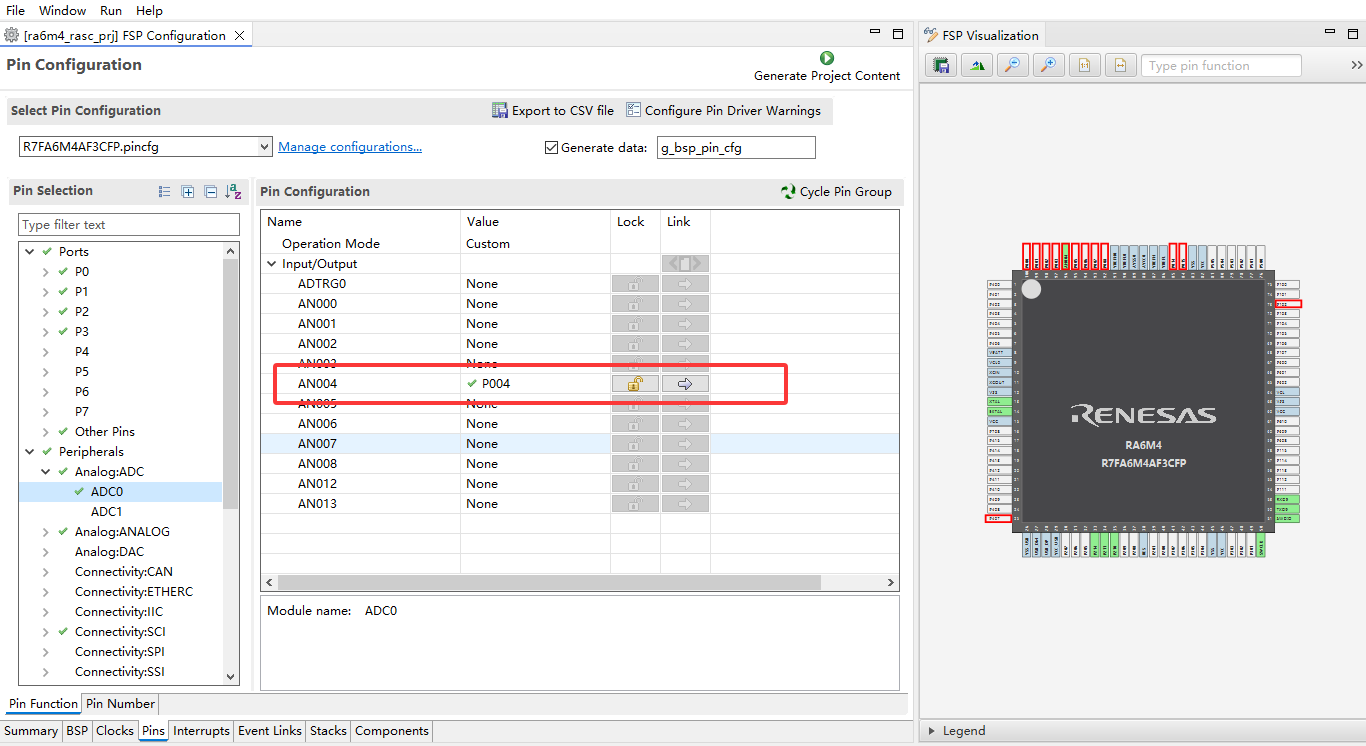
2.1、配置ADC引脚
配置P004为ADC输入引脚
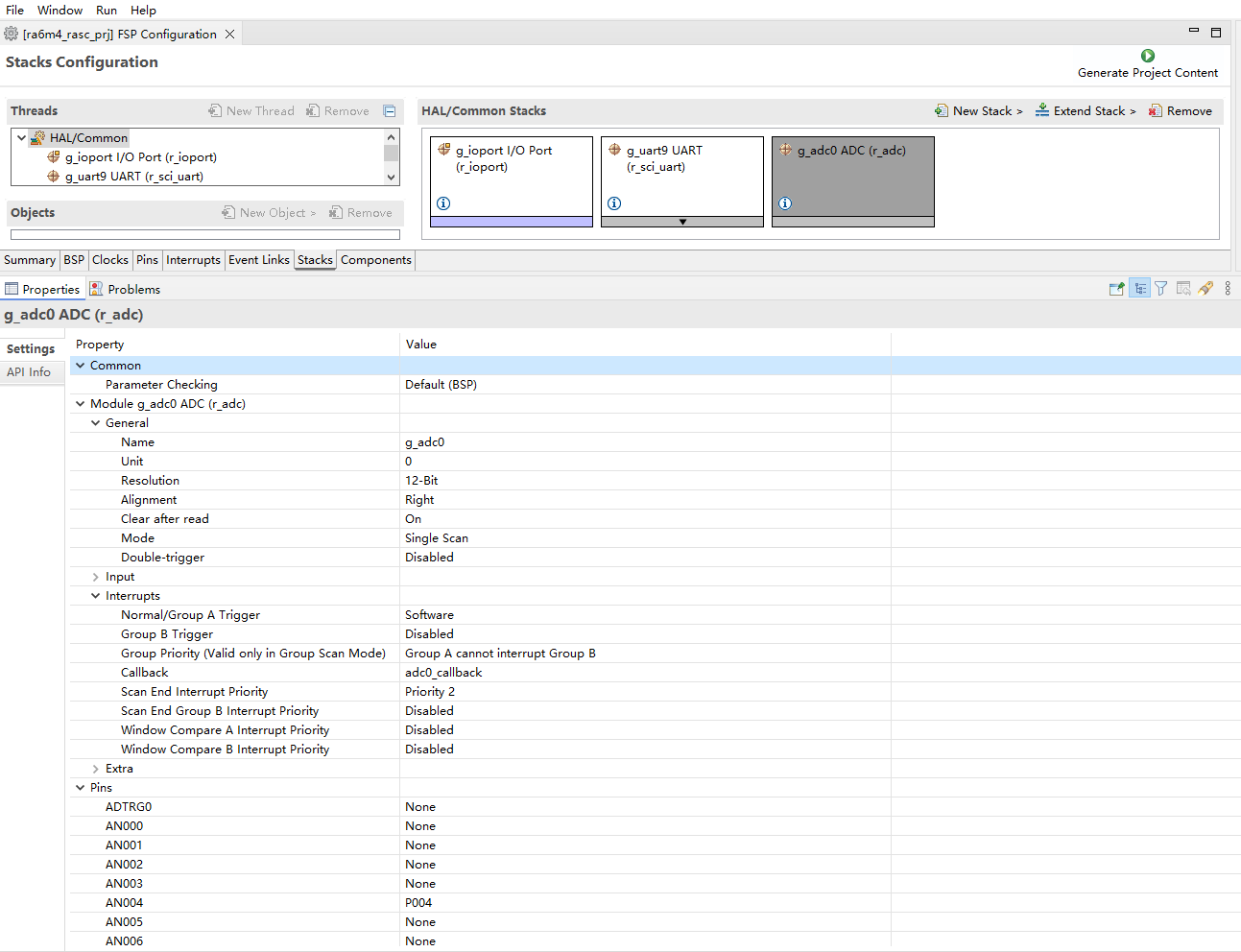
2.2、配置ADC参数
三、程序部分
3.1、fun_adc.c
#include "hal_data.h"

volatile bool scan_complete_flag = false;

void adc0_callback(adc_callback_args_t * p_args)
{
   FSP_PARAMETER_NOT_USED(p_args);
   scan_complete_flag = true;
}

double Read_ADC_Voltage_Value(void)
{
   uint16_t adc_data;
   double a0;

   (void)R_ADC_ScanStart(&g_adc0_ctrl);
   while (!scan_complete_flag)
   {
      ;
   }
   scan_complete_flag = false;

   R_ADC_Read(&g_adc0_ctrl, ADC_CHANNEL_4, &adc_data);

   a0 = (double)(adc_data*3.3/4095);

   return a0;
}

void init_adc(void)
{
   fsp_err_t err;
   err = R_ADC_Open(&g_adc0_ctrl, &g_adc0_cfg);
   err = R_ADC_ScanCfg(&g_adc0_ctrl, &g_adc0_channel_cfg);
   assert(FSP_SUCCESS == err);
}
3.2、fun_adc.h
#ifndef FUN_ADC_H_
#define FUN_ADC_H_

void init_adc(void);
double Read_ADC_Voltage_Value(void);

#endif
3.3、hal_entry.c
#include "hal_data.h"
#include "led/fun_led.h"
#include "uart/fun_uart.h"
#include "adc/fun_adc.h"


FSP_CPP_HEADER
void R_BSP_WarmStart(bsp_warm_start_event_t event);
FSP_CPP_FOOTER

/*******************************************************************************************************************//**
 * main() is generated by the RA Configuration editor and is used to generate threads if an RTOS is used.  This function
 * is called by main() when no RTOS is used.
 **********************************************************************************************************************/
void hal_entry(void)
{
	double adv=0.0;
    /* TODO: add your own code here */
	init_uart();
	init_led();
	init_adc();

	while(1)
	{
		R_BSP_SoftwareDelay(100, BSP_DELAY_UNITS_MILLISECONDS);
		led1_on();
		led2_off();
		led3_on();
		R_BSP_SoftwareDelay(100, BSP_DELAY_UNITS_MILLISECONDS);
		led1_off();
		led2_on();
		led3_off();
		adv = Read_ADC_Voltage_Value();
		printf("adc = %0.1f \r\n",adv);
		//printf("RA6M4 Board UART9 TEST!\r\n");
	}

#if BSP_TZ_SECURE_BUILD
    /* Enter non-secure code */
    R_BSP_NonSecureEnter();
#endif
}

/*******************************************************************************************************************//**
 * This function is called at various points during the startup process.  This implementation uses the event that is
 * called right before main() to set up the pins.
 *
 * @param[in]  event    Where at in the start up process the code is currently at
 **********************************************************************************************************************/
void R_BSP_WarmStart (bsp_warm_start_event_t event)
{
    if (BSP_WARM_START_RESET == event)
    {
#if BSP_FEATURE_FLASH_LP_VERSION != 0

        /* Enable reading from data flash. */
        R_FACI_LP->DFLCTL = 1U;

        /* Would normally have to wait tDSTOP(6us) for data flash recovery. Placing the enable here, before clock and
         * C runtime initialization, should negate the need for a delay since the initialization will typically take more than 6us. */
#endif
    }

    if (BSP_WARM_START_POST_C == event)
    {
        /* C runtime environment and system clocks are setup. */

        /* Configure pins. */
        R_IOPORT_Open(&IOPORT_CFG_CTRL, &IOPORT_CFG_NAME);

#if BSP_CFG_SDRAM_ENABLED

        /* Setup SDRAM and initialize it. Must configure pins first. */
        R_BSP_SdramInit(true);
#endif
    }
}

#if BSP_TZ_SECURE_BUILD

FSP_CPP_HEADER
BSP_CMSE_NONSECURE_ENTRY void template_nonsecure_callable ();

/* Trustzone Secure Projects require at least one nonsecure callable function in order to build (Remove this if it is not required to build). */
BSP_CMSE_NONSECURE_ENTRY void template_nonsecure_callable ()
{

}
FSP_CPP_FOOTER

#endif
四、运行结果
下载程序后,调整电位器,串口输出采样的电压值
| 
 电子发烧友论坛
 0
0
 /9
/9 



 工商网监
湘ICP备2023018690号
工商网监
湘ICP备2023018690号


 753
753
 淘帖
淘帖