一、引言
赛昉科技提供了许多参考性文档,其中不乏使用昉·星光 2测试在AI图像处理的应用场景。上期咱分享了二维码检测与解码效果,只要摄像头采集图像够清晰,扫描二维码与解析效率还是挺好的。今儿来分享一下,基于上期环境,再对摄像头应用进行展开,评估其在人脸识别、物体识别以及图像边缘检测上的应用。
二、人脸识别
(1)硬件搭建
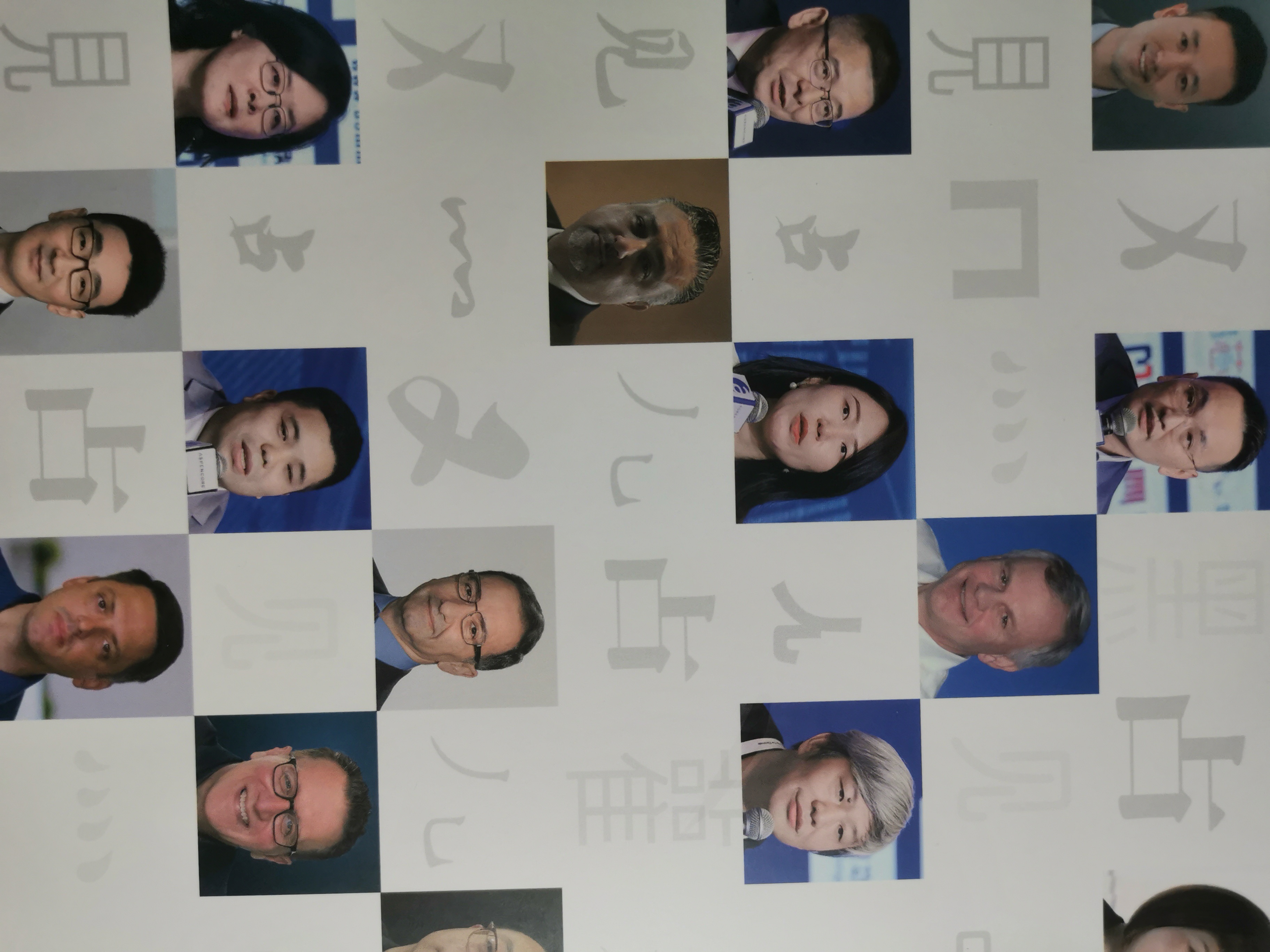
准备一本封面印有人脸头像的杂志,以便后续测试检测效果。
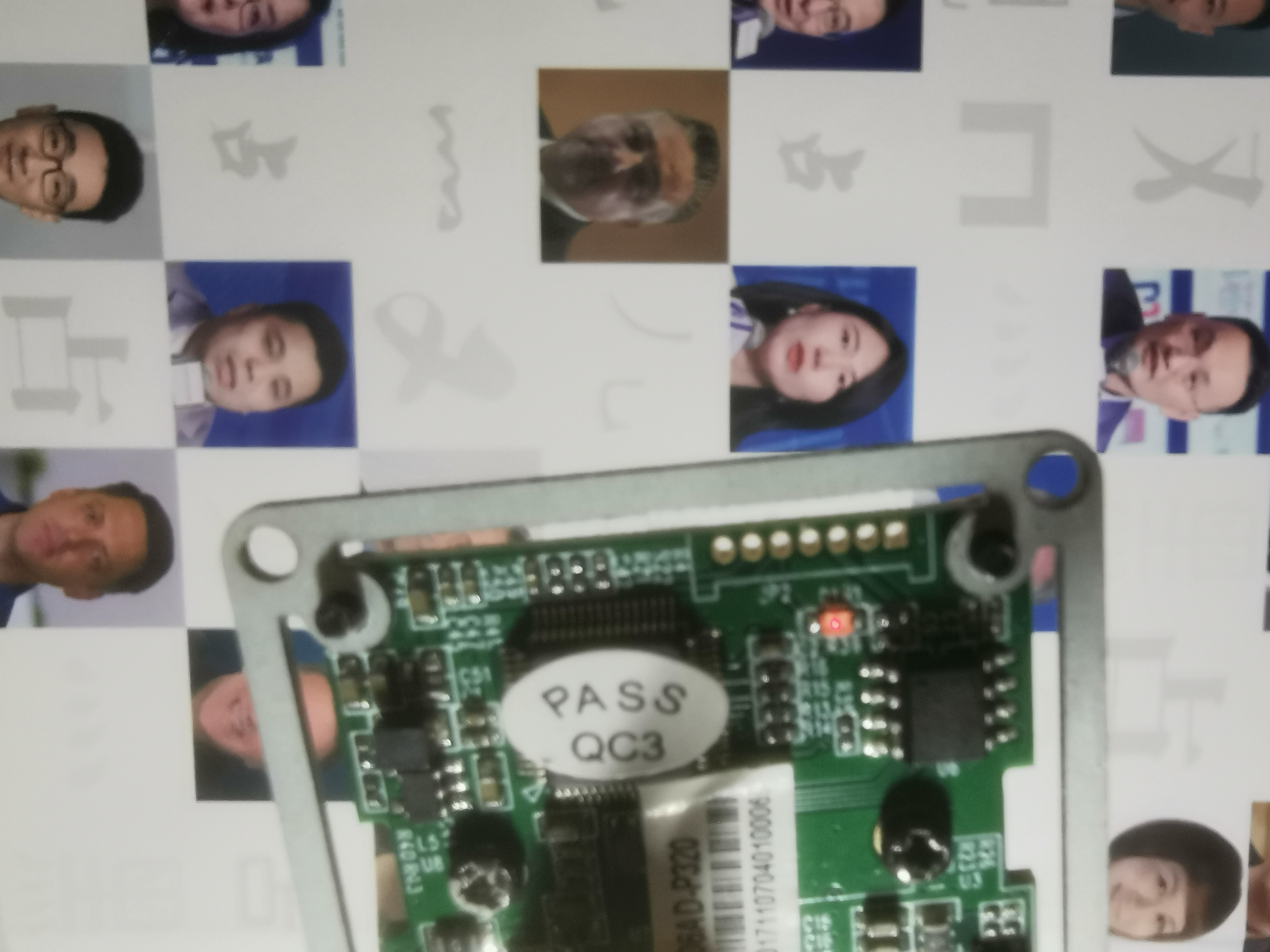
固定uvc摄像机,然后调好焦距,使其图像采集清晰。
(2)代码实现
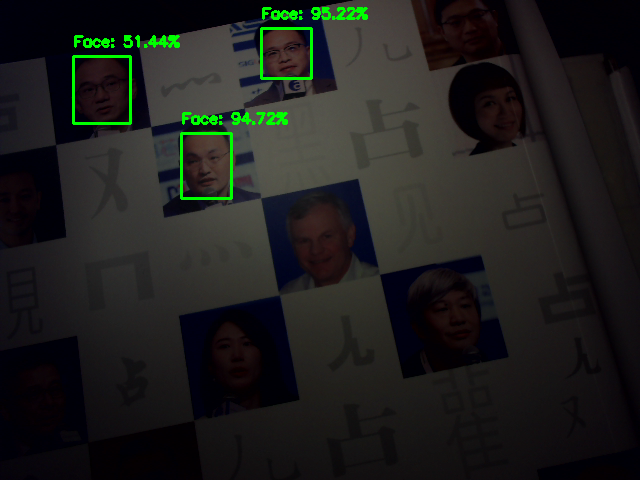
与上期的二维码检测实验一样,基于OpenCV模型去实现人脸图像检测、轮廓标注、置信度和识别。在人脸图像检测的同时,显示检测的置信度,置信度小于50%过滤掉。,因此需用到深度学习的检测模型,github上有提供开源的OpenCV DNN或FaceNet模型,可满足置信度显示需求。
准备预训练模型文件
通过github上获取“deploy.prototxt.txt”与“res10_300x300_ssd_iter_140000.caffemodel”文件。
*附件:deploy.prototxt.zip
*附件:res10_300x300_ssd_iter_140000.zip
编写“face_detection.py”源代码,内容如下:
import cv2
import numpy as np

net = cv2.dnn.readNetFromCaffe("deploy.prototxt.txt", "res10_300x300_ssd_iter_140000.caffemodel")

cap = cv2.VideoCapture(4, cv2.CAP_V4L2)

while True:
    ret, frame = cap.read()
    if not ret:
        break

    (h, w) = frame.shape[:2]
    blob = cv2.dnn.blobFromImage(cv2.resize(frame, (300, 300)), 1.0,
                                (300, 300), (104.0, 177.0, 123.0))
    net.setInput(blob)
    detections = net.forward()

    for i in range(detections.shape[2]):
        confidence = detections[0, 0, i, 2]

        if confidence < 0.5:
            continue
        box = detections[0, 0, i, 3:7] * np.array([w, h, w, h])
        (startX, startY, endX, endY) = box.astype("int")

        cv2.rectangle(frame, (startX, startY), (endX, endY), (0, 255, 0), 2)
        text = f"Face: {confidence * 100:.2f}%"
        cv2.putText(frame, text, (startX, startY - 10),
        cv2.FONT_HERSHEY_SIMPLEX, 0.5, (0, 255, 0), 2)

    cv2.imshow("Face Detection with Confidence", frame)
    key = cv2.waitKey(1) & 0xFF

    # if the `q` key was pressed, break from the loop
    if key == ord("q"):
        break

cap.release()
cv2.destroyAllWindows()
将编写好的“face_detection.py”源文件与上述下载好的预训练模型文件放在同一文件夹下。
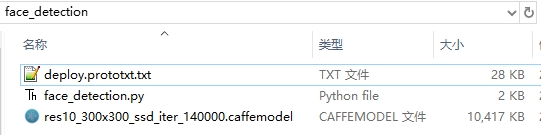
桌面方式登录后,然后终端中进到该文件夹下,普通用户身份执行“ python3 face_detection.py”,呈现的检测效果见底部视频。
三、物体识别
因为之前的二维码检测功能基本已实现,因此环境这块,相应的依赖软件包都已安装好了,这里调用YOLO-V3模型进行通用物体的识别。
基于yolo-v3模型的应用“object_detection.cpp”源代码如下:
#include <fstream>
#include <sstream>
#include <opencv2/dnn.hpp>
#include <opencv2/imgproc.hpp>
#include <opencv2/highgui.hpp>
#if defined(CV_CXX11) && defined(HAVE_THREADS)
#define USE_THREADS 1
#endif
#ifdef USE_THREADS
#include <mutex>
#include <thread>
#include <queue>
#endif
#include "common.hpp"
std::string keys =
"{ help h | | Print help message. }"
"{ [url=home.php?mod=space&uid=204129]@Alias[/url] | | An alias name of model to extract preprocessing parameters from models.yml file. }"
"{ zoo | models.yml | An optional path to file with preprocessing parameters }"
"{ device | 0 | camera device number. }"
"{ input i | | Path to input image or video file. Skip this argument to capture frames from a camera. }"
"{ framework f | | Optional name of an origin framework of the model. Detect it automatically if it does not set. }"
"{ classes | | Optional path to a text file with names of classes to label detected objects. }"
"{ thr | .5 | Confidence threshold. }"
"{ nms | .4 | Non-maximum suppression threshold. }"
"{ backend | 0 | Choose one of computation backends: "
"0: automatically (by default), "
"1: Halide language (http://halide-lang.org/), "
"2: Intel's Deep Learning Inference Engine (https://software.intel.com/openvino-toolkit), "
"3: OpenCV implementation, "
"4: VKCOM, "
"5: CUDA }"
"{ target | 0 | Choose one of target computation devices: "
"0: CPU target (by default), "
"1: OpenCL, "
"2: OpenCL fp16 (half-float precision), "
"3: VPU, "
"4: Vulkan, "
"6: CUDA, "
"7: CUDA fp16 (half-float preprocess) }"
"{ async | 0 | Number of asynchronous forwards at the same time. "
"Choose 0 for synchronous mode }";
using namespace cv;
using namespace dnn;
float confThreshold, nmsThreshold;
std::vector<std::string> classes;
inline void preprocess(const Mat& frame, Net& net, Size inpSize, float scale,
const Scalar& mean, bool swapRB);
void postprocess(Mat& frame, const std::vector<Mat>& out, Net& net, int backend);
void drawPred(int classId, float conf, int left, int top, int right, int bottom, Mat& frame);
void callback(int pos, void* userdata);
#ifdef USE_THREADS
template <typename T>
class QueueFPS : public std::queue<T>
{
public:
QueueFPS() : counter(0) {}
void push(const T& entry)
{
std::lock_guard<std::mutex> lock(mutex);
std::queue<T>::push(entry);
counter += 1;
if (counter == 1)
{
tm.reset();
tm.start();
}
}
T get()
{
std::lock_guard<std::mutex> lock(mutex);
T entry = this->front();
this->pop();
return entry;
}
float getFPS()
{
tm.stop();
double fps = counter / tm.getTimeSec();
tm.start();
return static_cast<float>(fps);
}
void clear()
{
std::lock_guard<std::mutex> lock(mutex);
while (!this->empty())
this->pop();
}
unsigned int counter;
private:
TickMeter tm;
std::mutex mutex;
};
#endif
int main(int argc, char** argv)
{
CommandLineParser parser(argc, argv, keys);
const std::string modelName = parser.get<String>("@alias");
const std::string zooFile = parser.get<String>("zoo");
keys += genPreprocArguments(modelName, zooFile);
parser = CommandLineParser(argc, argv, keys);
parser.about("Use this script to run object detection deep learning networks using OpenCV.");
if (argc == 1 || parser.has("help"))
{
parser.printMessage();
return 0;
}
confThreshold = parser.get<float>("thr");
nmsThreshold = parser.get<float>("nms");
float scale = parser.get<float>("scale");
Scalar mean = parser.get<Scalar>("mean");
bool swapRB = parser.get<bool>("rgb");
int inpWidth = parser.get<int>("width");
int inpHeight = parser.get<int>("height");
size_t asyncNumReq = parser.get<int>("async");
CV_Assert(parser.has("model"));
std::string modelPath = findFile(parser.get<String>("model"));
std::string configPath = findFile(parser.get<String>("config"));
if (parser.has("classes"))
{
std::string file = parser.get<String>("classes");
std::ifstream ifs(file.c_str());
if (!ifs.is_open())
CV_Error(Error::StsError, "File " + file + " not found");
std::string line;
while (std::getline(ifs, line))
{
classes.push_back(line);
}
}
Net net = readNet(modelPath, configPath, parser.get<String>("framework"));
int backend = parser.get<int>("backend");
net.setPreferableBackend(backend);
net.setPreferableTarget(parser.get<int>("target"));
std::vector<String> outNames = net.getUnconnectedOutLayersNames();
static const std::string kWinName = "Deep learning object detection in OpenCV";
namedWindow(kWinName, WINDOW_NORMAL);
int initialConf = (int)(confThreshold * 100);
createTrackbar("Confidence threshold, %", kWinName, &initialConf, 99, callback);
VideoCapture cap;
if (parser.has("input"))
cap.open(parser.get<String>("input"));
else
cap.open(parser.get<int>("device"));
#ifdef USE_THREADS
bool process = true;
QueueFPS<Mat> framesQueue;
std::thread framesThread([&](){
Mat frame;
while (process)
{
cap >> frame;
if (!frame.empty())
framesQueue.push(frame.clone());
else
break;
}
});
QueueFPS<Mat> processedFramesQueue;
QueueFPS<std::vector<Mat> > predictionsQueue;
std::thread processingThread([&](){
std::queue<AsyncArray> futureOutputs;
Mat blob;
while (process)
{
Mat frame;
{
if (!framesQueue.empty())
{
frame = framesQueue.get();
if (asyncNumReq)
{
if (futureOutputs.size() == asyncNumReq)
frame = Mat();
}
else
framesQueue.clear();
}
}
if (!frame.empty())
{
preprocess(frame, net, Size(inpWidth, inpHeight), scale, mean, swapRB);
processedFramesQueue.push(frame);
if (asyncNumReq)
{
futureOutputs.push(net.forwardAsync());
}
else
{
std::vector<Mat> outs;
net.forward(outs, outNames);
predictionsQueue.push(outs);
}
}
while (!futureOutputs.empty() &&
futureOutputs.front().wait_for(std::chrono::seconds(0)))
{
AsyncArray async_out = futureOutputs.front();
futureOutputs.pop();
Mat out;
async_out.get(out);
predictionsQueue.push({out});
}
}
});
while (waitKey(1) < 0)
{
if (predictionsQueue.empty())
continue;
std::vector<Mat> outs = predictionsQueue.get();
Mat frame = processedFramesQueue.get();
postprocess(frame, outs, net, backend);
if (predictionsQueue.counter > 1)
{
std::string label = format("Camera: %.2f FPS", framesQueue.getFPS());
putText(frame, label, Point(0, 15), FONT_HERSHEY_SIMPLEX, 0.5, Scalar(0, 255, 0));
label = format("Network: %.2f FPS", predictionsQueue.getFPS());
putText(frame, label, Point(0, 30), FONT_HERSHEY_SIMPLEX, 0.5, Scalar(0, 255, 0));
label = format("Skipped frames: %d", framesQueue.counter - predictionsQueue.counter);
putText(frame, label, Point(0, 45), FONT_HERSHEY_SIMPLEX, 0.5, Scalar(0, 255, 0));
}
imshow(kWinName, frame);
}
process = false;
framesThread.join();
processingThread.join();
#else
if (asyncNumReq)
CV_Error(Error::StsNotImplemented, "Asynchronous forward is supported only with Inference Engine backend.");
Mat frame, blob;
while (waitKey(1) < 0)
{
cap >> frame;
if (frame.empty())
{
waitKey();
break;
}
preprocess(frame, net, Size(inpWidth, inpHeight), scale, mean, swapRB);
std::vector<Mat> outs;
net.forward(outs, outNames);
postprocess(frame, outs, net, backend);
std::vector<double> layersTimes;
double freq = getTickFrequency() / 1000;
double t = net.getPerfProfile(layersTimes) / freq;
std::string label = format("Inference time: %.2f ms", t);
putText(frame, label, Point(0, 15), FONT_HERSHEY_SIMPLEX, 0.5, Scalar(0, 255, 0));
imshow(kWinName, frame);
}
#endif
return 0;
}
inline void preprocess(const Mat& frame, Net& net, Size inpSize, float scale,
const Scalar& mean, bool swapRB)
{
static Mat blob;
if (inpSize.width <= 0) inpSize.width = frame.cols;
if (inpSize.height <= 0) inpSize.height = frame.rows;
blobFromImage(frame, blob, 1.0, inpSize, Scalar(), swapRB, false, CV_8U);
net.setInput(blob, "", scale, mean);
if (net.getLayer(0)->outputNameToIndex("im_info") != -1)
{
resize(frame, frame, inpSize);
Mat imInfo = (Mat_<float>(1, 3) << inpSize.height, inpSize.width, 1.6f);
net.setInput(imInfo, "im_info");
}
}
void postprocess(Mat& frame, const std::vector<Mat>& outs, Net& net, int backend)
{
static std::vector<int> outLayers = net.getUnconnectedOutLayers();
static std::string outLayerType = net.getLayer(outLayers[0])->type;
std::vector<int> classIds;
std::vector<float> confidences;
std::vector<Rect> boxes;
if (outLayerType == "DetectionOutput")
{
CV_Assert(outs.size() > 0);
for (size_t k = 0; k < outs.size(); k++)
{
float* data = (float*)outs[k].data;
for (size_t i = 0; i < outs[k].total(); i += 7)
{
float confidence = data[i + 2];
if (confidence > confThreshold)
{
int left = (int)data[i + 3];
int top = (int)data[i + 4];
int right = (int)data[i + 5];
int bottom = (int)data[i + 6];
int width = right - left + 1;
int height = bottom - top + 1;
if (width <= 2 || height <= 2)
{
left = (int)(data[i + 3] * frame.cols);
top = (int)(data[i + 4] * frame.rows);
right = (int)(data[i + 5] * frame.cols);
bottom = (int)(data[i + 6] * frame.rows);
width = right - left + 1;
height = bottom - top + 1;
}
classIds.push_back((int)(data[i + 1]) - 1);
boxes.push_back(Rect(left, top, width, height));
confidences.push_back(confidence);
}
}
}
}
else if (outLayerType == "Region")
{
for (size_t i = 0; i < outs.size(); ++i)
{
float* data = (float*)outs[i].data;
for (int j = 0; j < outs[i].rows; ++j, data += outs[i].cols)
{
Mat scores = outs[i].row(j).colRange(5, outs[i].cols);
Point classIdPoint;
double confidence;
minMaxLoc(scores, 0, &confidence, 0, &classIdPoint);
if (confidence > confThreshold)
{
int centerX = (int)(data[0] * frame.cols);
int centerY = (int)(data[1] * frame.rows);
int width = (int)(data[2] * frame.cols);
int height = (int)(data[3] * frame.rows);
int left = centerX - width / 2;
int top = centerY - height / 2;
classIds.push_back(classIdPoint.x);
confidences.push_back((float)confidence);
boxes.push_back(Rect(left, top, width, height));
}
}
}
}
else
CV_Error(Error::StsNotImplemented, "Unknown output layer type: " + outLayerType);
if (outLayers.size() > 1 || (outLayerType == "Region" && backend != DNN_BACKEND_OPENCV))
{
std::map<int, std::vector<size_t> > class2indices;
for (size_t i = 0; i < classIds.size(); i++)
{
if (confidences[i] >= confThreshold)
{
class2indices[classIds[i]].push_back(i);
}
}
std::vector<Rect> nmsBoxes;
std::vector<float> nmsConfidences;
std::vector<int> nmsClassIds;
for (std::map<int, std::vector<size_t> >::iterator it = class2indices.begin(); it != class2indices.end(); ++it)
{
std::vector<Rect> localBoxes;
std::vector<float> localConfidences;
std::vector<size_t> classIndices = it->second;
for (size_t i = 0; i < classIndices.size(); i++)
{
localBoxes.push_back(boxes[classIndices[i]]);
localConfidences.push_back(confidences[classIndices[i]]);
}
std::vector<int> nmsIndices;
NMSBoxes(localBoxes, localConfidences, confThreshold, nmsThreshold, nmsIndices);
for (size_t i = 0; i < nmsIndices.size(); i++)
{
size_t idx = nmsIndices[i];
nmsBoxes.push_back(localBoxes[idx]);
nmsConfidences.push_back(localConfidences[idx]);
nmsClassIds.push_back(it->first);
}
}
boxes = nmsBoxes;
classIds = nmsClassIds;
confidences = nmsConfidences;
}
for (size_t idx = 0; idx < boxes.size(); ++idx)
{
Rect box = boxes[idx];
drawPred(classIds[idx], confidences[idx], box.x, box.y,
box.x + box.width, box.y + box.height, frame);
}
}
void drawPred(int classId, float conf, int left, int top, int right, int bottom, Mat& frame)
{
rectangle(frame, Point(left, top), Point(right, bottom), Scalar(0, 255, 0));
std::string label = format("%.2f", conf);
if (!classes.empty())
{
CV_Assert(classId < (int)classes.size());
label = classes[classId] + ": " + label;
}
int baseLine;
Size labelSize = getTextSize(label, FONT_HERSHEY_SIMPLEX, 0.5, 1, &baseLine);
top = max(top, labelSize.height);
rectangle(frame, Point(left, top - labelSize.height),
Point(left + labelSize.width, top + baseLine), Scalar::all(255), FILLED);
putText(frame, label, Point(left, top), FONT_HERSHEY_SIMPLEX, 0.5, Scalar());
}
void callback(int pos, void*)
{
confThreshold = pos * 0.01f;
}
桌面方式登录后,终端中user身份直接运行“v4l2-ctl --list-device”指令,确认USB摄像机的ID号。然后再运行“example_dnn_object_detection --config=/usr/share/opencv4/yolo-v3/yolov3-tiny.cfg --model=/usr/share/opencv4/yolo-v3/yolov3-tiny.weights --classes=/usr/share/opencv4/yolo-v3/classes.txt --width=416--height=416--scale=0.00392--rgb --target=1--device=4”

四、图像边缘检测
这里调用OpenCV官方提供的“edge.py”源文件,内容如下:
'''
This sample demonstrates Canny edge detection.
Usage:
edge.py [<video source>]
Trackbars control edge thresholds.
'''
from __future__ import print_function
import cv2 as cv
import numpy as np
import video
import sys
def main():
try:
fn = sys.argv[1]
cam = int(fn)
except:
fn = 0
def nothing(*arg):
pass
cv.namedWindow('edge', 0)
cv.resizeWindow('edge', 640, 480)
cv.createTrackbar('thrs1', 'edge', 2000, 5000, nothing)
cv.createTrackbar('thrs2', 'edge', 4000, 5000, nothing)
cap = cv.VideoCapture(cam, cv.CAP_V4L2)
if cam == 1:
cap.set(cv.CAP_PROP_CONVERT_RGB, 0)
while True:
if cam == 1:
ret, img_origin = cap.read()
img = cv.cvtColor(img_origin, cv.COLOR_YUV2BGR_NV12)
else:
ret, img = cap.read()
gray = cv.cvtColor(img, cv.COLOR_BGR2GRAY)
thrs1 = cv.getTrackbarPos('thrs1', 'edge')
thrs2 = cv.getTrackbarPos('thrs2', 'edge')
edge = cv.Canny(gray, thrs1, thrs2, apertureSize=5)
vis = img.copy()
vis = np.uint8(vis/2.)
vis[edge != 0] = (0, 255, 0)
cv.imshow('edge', vis)
ch = cv.waitKey(5)
if ch == 27:
break
print('Done')
if __name__ == '__main__':
print(__doc__)
main()
cv.destroyAllWindows()
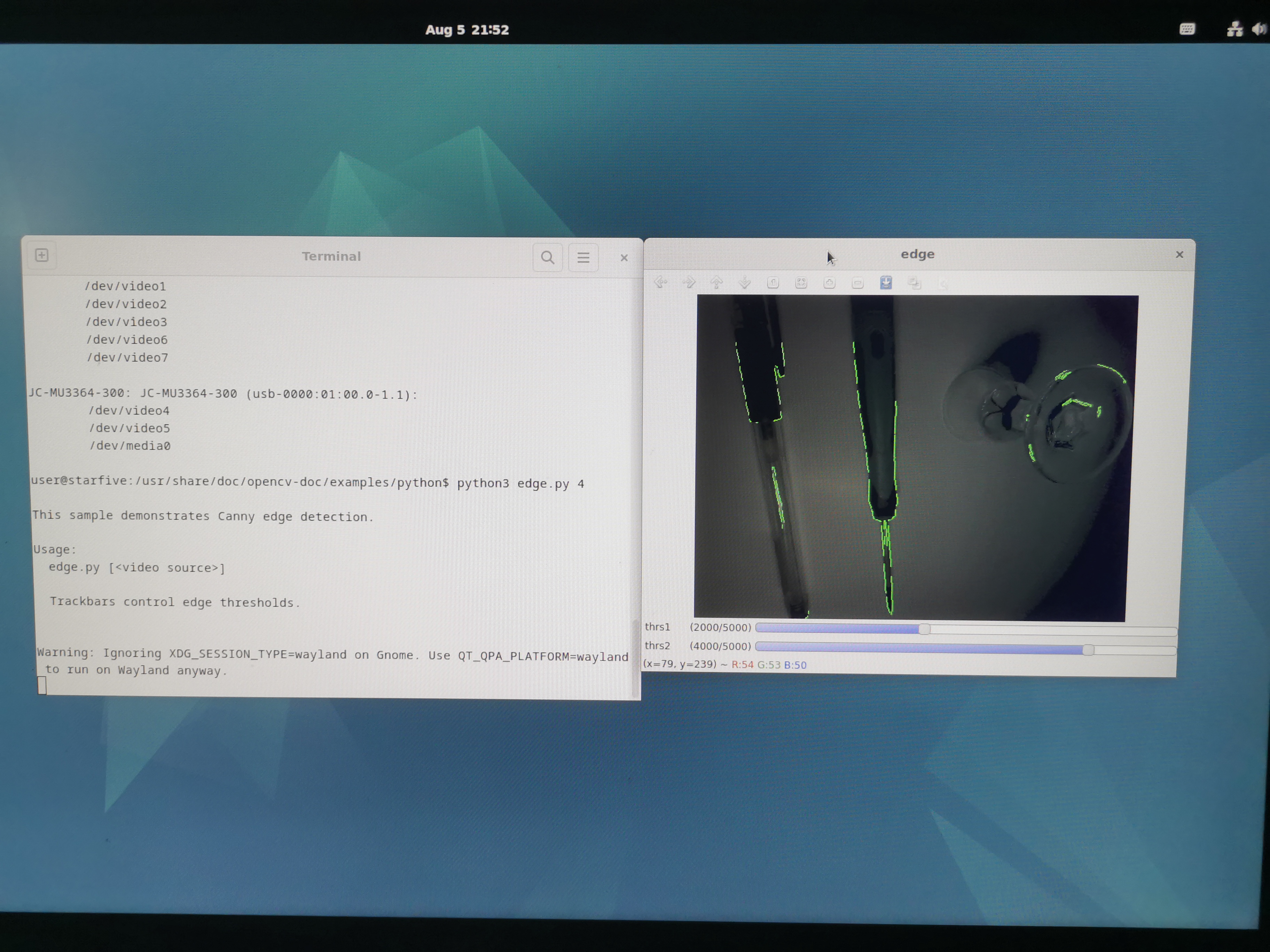
同样的,桌面方式登录后,终端中user身份直接运行“v4l2-ctl --list-device”指令,确认USB摄像机的ID号。然后再运行:
cd /usr/share/doc/opencv-doc/examples/python/
python3 edge.py 4
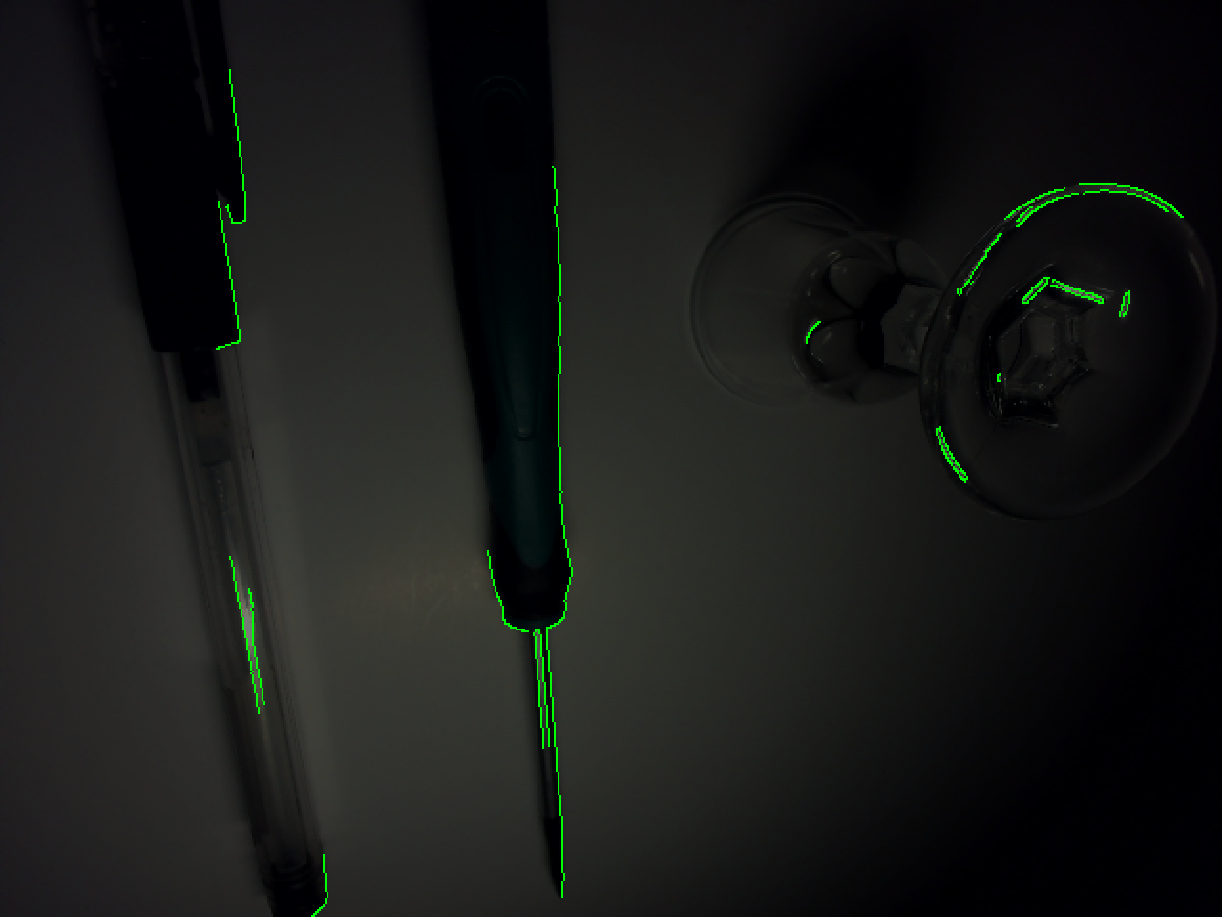
默认参数下运行效果如下:
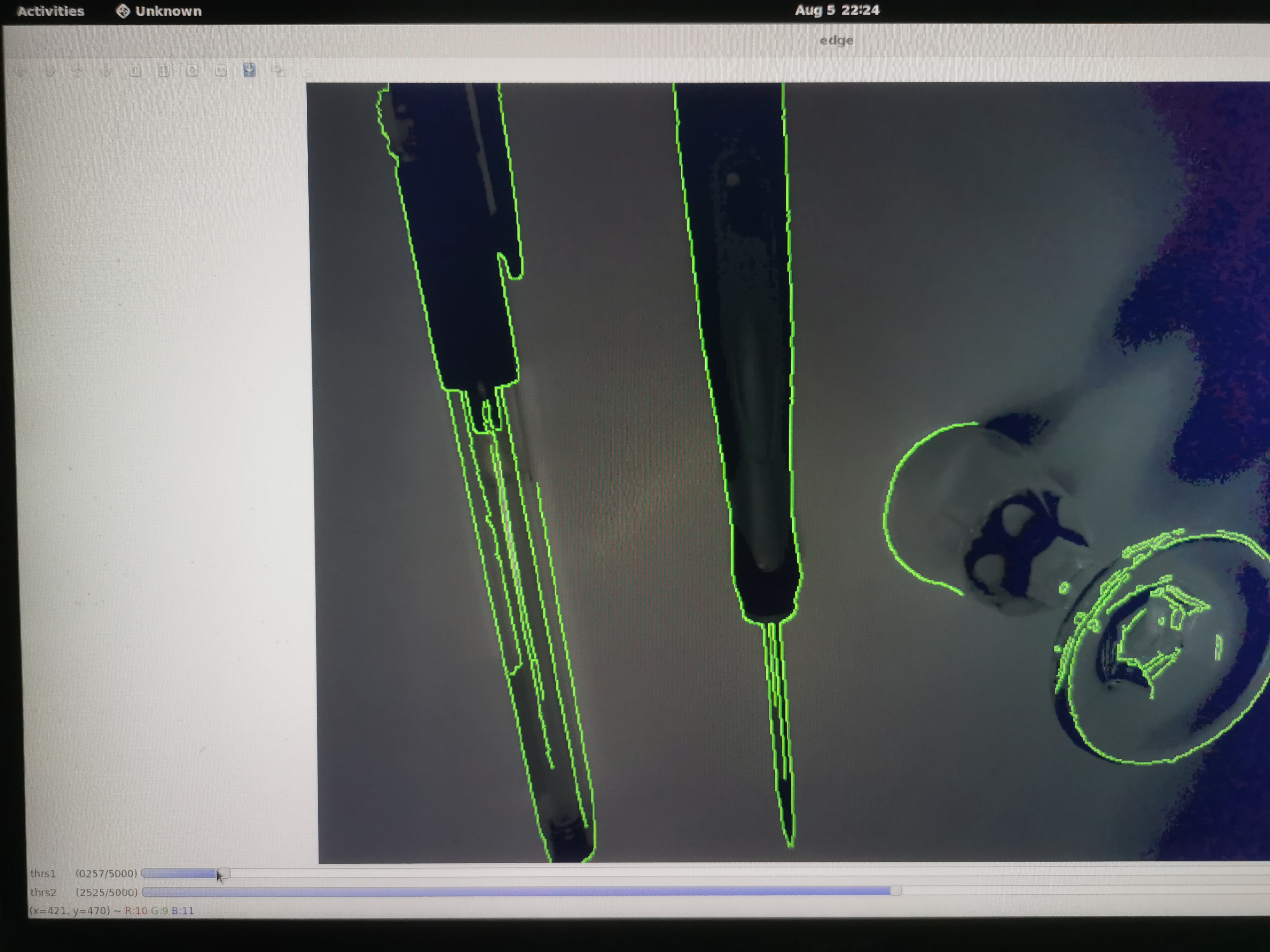
调节thrs1、thrs2参数后,检测的图像边缘区分更明显。
五、小结
综上评测效果,昉·星光2连接一个通用的USB摄像机,即可高效实现基于OpenCV的人脸检测识别、通用物体识别、二维码检测与解析,图像边缘检测等功能,证实该开发板可以运用在AI智能终端产品设计上,赛昉科技也提供了诸多指导性文档,一个应用可通过多种模型来实现,有提供C++源代码方式的接口,也有python源代码。提供的参考例程很有代表性,足见该开发板应用的场景广泛,尤其是在边缘AI设计中,具有很好的市场竞争力。

 0
0
 /9
/9 



 工商网监
湘ICP备2023018690号
工商网监
湘ICP备2023018690号


 519
519

 淘帖
淘帖