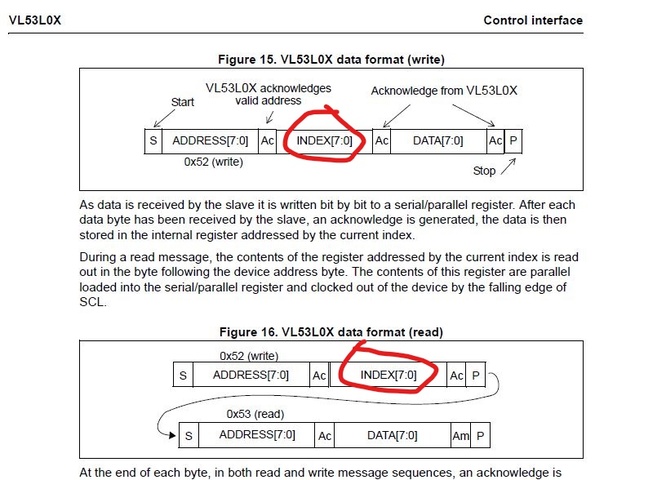
我的代码和控制台如下所示。控制台上的值是固定的,即使我在传感器前面移动一个物体,它们也不会改变。我也不明白我应该在数据表中显示的“索引”字节中放入什么。
- /* USER CODE BEGIN Header */
- /**
- ******************************************************************************
- * @file : main.c
- * @brief : Main program body
- ******************************************************************************
- * @attention
- *
- *
© Copyright (c) 2021 STMicroelectronics.- * All rights reserved.
- *
- * This software component is licensed by ST under BSD 3-Clause license,
- * the "License"; You may not use this file except in compliance with the
- * License. You may obtain a copy of the License at:
- * opensource.org/licenses/BSD-3-Clause
- *
- ******************************************************************************
- */
- /* USER CODE END Header */
- /* Includes ------------------------------------------------------------------*/
- #include "main.h"
- #include
- #include
- /* Private includes ----------------------------------------------------------*/
- /* USER CODE BEGIN Includes */
- /* USER CODE END Includes */
- /* Private typedef -----------------------------------------------------------*/
- /* USER CODE BEGIN PTD */
- /* USER CODE END PTD */
- /* Private define ------------------------------------------------------------*/
- /* USER CODE BEGIN PD */
- /* USER CODE END PD */
- /* Private macro -------------------------------------------------------------*/
- /* USER CODE BEGIN PM */
- /* USER CODE END PM */
- /* Private variables ---------------------------------------------------------*/
- I2C_HandleTypeDef hi2c1;
- UART_HandleTypeDef huart2;
- /* USER CODE BEGIN PV */
- static const uint8_t VL53L0_I2C_ADDR = 0x52;
- /* USER CODE END PV */
- /* Private function prototypes -----------------------------------------------*/
- void SystemClock_Config(void);
- static void MX_GPIO_Init(void);
- static void MX_I2C1_Init(void);
- static void MX_USART2_UART_Init(void);
- /* USER CODE BEGIN PFP */
- /* USER CODE END PFP */
- /* Private user code ---------------------------------------------------------*/
- /* USER CODE BEGIN 0 */
- /* USER CODE END 0 */
- /**
- * @brief The application entry point.
- * @retval int
- */
- int main(void)
- {
- /* USER CODE BEGIN 1 */
- HAL_StatusTypeDef ret;
- uint8_t buf[12];
- uint16_t distance;
- /* USER CODE END 1 */
- /* MCU Configuration--------------------------------------------------------*/
- /* Reset of all peripherals, Initializes the Flash interface and the Systick. */
- HAL_Init();
- /* USER CODE BEGIN Init */
- /* USER CODE END Init */
- /* Configure the system clock */
- SystemClock_Config();
- /* USER CODE BEGIN SysInit */
- /* USER CODE END SysInit */
- /* Initialize all configured peripherals */
- MX_GPIO_Init();
- MX_I2C1_Init();
- MX_USART2_UART_Init();
- /* USER CODE BEGIN 2 */
- /* USER CODE END 2 */
- /* Infinite loop */
- /* USER CODE BEGIN WHILE */
- while (1)
- {
- /* USER CODE END WHILE */
- ret = HAL_I2C_IsDeviceReady(&hi2c1, VL53L0_I2C_ADDR, 1, HAL_MAX_DELAY);
- if ( ret != HAL_OK ){
- strcpy((char*)buf,"Error adr
"); - } else {
- ret = HAL_I2C_Master_Transmit(&hi2c1, VL53L0_I2C_ADDR, buf, 1, HAL_MAX_DELAY);
- // ret = HAL_I2C_Mem_Write(&hi2c1, VL53L0X, reg, 1, buf, 1, HAL_MAX_DELAY);
- if ( ret != HAL_OK ) {
- strcpy((char*)buf,"Error tx
"); - } else {
- ret = HAL_I2C_Master_Receive(&hi2c1, VL53L0_I2C_ADDR|0x01, buf, 1, HAL_MAX_DELAY);
- // ret = HAL_I2C_Mem_Read(&hi2c1, VL53L0X, reg, 1, buf, 1, HAL_MAX_DELAY);
- if ( ret != HAL_OK ) {
- strcpy((char*)buf,"Error rx
"); - } else {
- distance = buf[0];
- sprintf((char*)buf,"%u
",(unsigned int)distance); - }
- }
- }
- // Send out buffer (distance or error message)
- HAL_Delay(500);
- printf("Distance=%u
",distance); - HAL_UART_Transmit(&huart2, buf, strlen((char*)buf), HAL_MAX_DELAY);
- /* USER CODE BEGIN 3 */
- }
- /* USER CODE END 3 */
- }
- /**
- * @brief System Clock Configuration
- * @retval None
- */
- void SystemClock_Config(void)
- {
- RCC_OscInitTypeDef RCC_OscInitStruct = {0};
- RCC_ClkInitTypeDef RCC_ClkInitStruct = {0};
- RCC_PeriphCLKInitTypeDef PeriphClkInit = {0};
- /** Initializes the RCC Oscillators according to the specified parameters
- * in the RCC_OscInitTypeDef structure.
- */
- RCC_OscInitStruct.OscillatorType = RCC_OSCILLATORTYPE_HSI;
- RCC_OscInitStruct.HSIState = RCC_HSI_ON;
- RCC_OscInitStruct.HSICalibrationValue = RCC_HSICALIBRATION_DEFAULT;
- RCC_OscInitStruct.PLL.PLLState = RCC_PLL_NONE;
- if (HAL_RCC_OscConfig(&RCC_OscInitStruct) != HAL_OK)
- {
- Error_Handler();
- }
- /** Initializes the CPU, AHB and APB buses clocks
- */
- RCC_ClkInitStruct.ClockType = RCC_CLOCKTYPE_HCLK|RCC_CLOCKTYPE_SYSCLK
- |RCC_CLOCKTYPE_PCLK1|RCC_CLOCKTYPE_PCLK2;
- RCC_ClkInitStruct.SYSCLKSource = RCC_SYSCLKSOURCE_HSI;
- RCC_ClkInitStruct.AHBCLKDivider = RCC_SYSCLK_DIV1;
- RCC_ClkInitStruct.APB1CLKDivider = RCC_HCLK_DIV1;
- RCC_ClkInitStruct.APB2CLKDivider = RCC_HCLK_DIV1;
- if (HAL_RCC_ClockConfig(&RCC_ClkInitStruct, FLASH_LATENCY_0) != HAL_OK)
- {
- Error_Handler();
- }
- PeriphClkInit.PeriphClockSelection = RCC_PERIPHCLK_I2C1;
- PeriphClkInit.I2c1ClockSelection = RCC_I2C1CLKSOURCE_HSI;
- if (HAL_RCCEx_PeriphCLKConfig(&PeriphClkInit) != HAL_OK)
- {
- Error_Handler();
- }
- }
- /**
- * @brief I2C1 Initialization Function
- * @param None
- * @retval None
- */
- static void MX_I2C1_Init(void)
- {
- /* USER CODE BEGIN I2C1_Init 0 */
- /* USER CODE END I2C1_Init 0 */
- /* USER CODE BEGIN I2C1_Init 1 */
- /* USER CODE END I2C1_Init 1 */
- hi2c1.Instance = I2C1;
- hi2c1.Init.Timing = 0x2000090E;
- hi2c1.Init.OwnAddress1 = 0;
- hi2c1.Init.AddressingMode = I2C_ADDRESSINGMODE_7BIT;
- hi2c1.Init.DualAddressMode = I2C_DUALADDRESS_DISABLE;
- hi2c1.Init.OwnAddress2 = 0;
- hi2c1.Init.OwnAddress2Masks = I2C_OA2_NOMASK;
- hi2c1.Init.GeneralCallMode = I2C_GENERALCALL_DISABLE;
- hi2c1.Init.NoStretchMode = I2C_NOSTRETCH_DISABLE;
- if (HAL_I2C_Init(&hi2c1) != HAL_OK)
- {
- Error_Handler();
- }
- /** Configure Analogue filter
- */
- if (HAL_I2CEx_ConfigAnalogFilter(&hi2c1, I2C_ANALOGFILTER_ENABLE) != HAL_OK)
- {
- Error_Handler();
- }
- /** Configure Digital filter
- */
- if (HAL_I2CEx_ConfigDigitalFilter(&hi2c1, 0) != HAL_OK)
- {
- Error_Handler();
- }
- /* USER CODE BEGIN I2C1_Init 2 */
- /* USER CODE END I2C1_Init 2 */
- }
- /**
- * @brief USART2 Initialization Function
- * @param None
- * @retval None
- */
- static void MX_USART2_UART_Init(void)
- {
- /* USER CODE BEGIN USART2_Init 0 */
- /* USER CODE END USART2_Init 0 */
- /* USER CODE BEGIN USART2_Init 1 */
- /* USER CODE END USART2_Init 1 */
- huart2.Instance = USART2;
- huart2.Init.BaudRate = 115200;
- huart2.Init.WordLength = UART_WORDLENGTH_8B;
- huart2.Init.StopBits = UART_STOPBITS_1;
- huart2.Init.Parity = UART_PARITY_NONE;
- huart2.Init.Mode = UART_MODE_TX_RX;
- huart2.Init.HwFlowCtl = UART_HWCONTROL_NONE;
- huart2.Init.OverSampling = UART_OVERSAMPLING_16;
- huart2.Init.OneBitSampling = UART_ONE_BIT_SAMPLE_DISABLE;
- huart2.AdvancedInit.AdvFeatureInit = UART_ADVFEATURE_NO_INIT;
- if (HAL_UART_Init(&huart2) != HAL_OK)
- {
- Error_Handler();
- }
- /* USER CODE BEGIN USART2_Init 2 */
- /* USER CODE END USART2_Init 2 */
- }
- /**
- * @brief GPIO Initialization Function
- * @param None
- * @retval None
- */
- static void MX_GPIO_Init(void)
- {
- /* GPIO Ports Clock Enable */
- __HAL_RCC_GPIOA_CLK_ENABLE();
- __HAL_RCC_GPIOB_CLK_ENABLE();
- }
- /* USER CODE BEGIN 4 */
- /* USER CODE END 4 */
- /**
- * @brief This function is executed in case of error occurrence.
- * @retval None
- */
- void Error_Handler(void)
- {
- /* USER CODE BEGIN Error_Handler_Debug */
- /* User can add his own implementation to report the HAL error return state */
- __disable_irq();
- while (1)
- {
- }
- /* USER CODE END Error_Handler_Debug */
- }
- #ifdef USE_FULL_ASSERT
- /**
- * @brief Reports the name of the source file and the source line number
- * where the assert_param error has occurred.
- * @param file: pointer to the source file name
- * @param line: assert_param error line source number
- * @retval None
- */
- void assert_failed(uint8_t *file, uint32_t line)
- {
- /* USER CODE BEGIN 6 */
- /* User can add his own implementation to report the file name and line number,
- ex: printf("Wrong parameters value: file %s on line %d
", file, line) */ - /* USER CODE END 6 */
- }
- #endif /* USE_FULL_ASSERT */
- /************************ (C) COPYRIGHT STMicroelectronics *****END OF FILE****/


 举报
举报


