

| 1 2 | # load all data dataset = read_csv('household_power_consumption.txt', sep=';', header=0, low_memory=False, infer_datetime_format=True, parse_dates={'datetime':[0,1]}, index_col=['datetime']) |
| 1 2 3 4 | # mark all missing values dataset.replace('?', nan, inplace=True) # make dataset numeric dataset = dataset.astype('float32') |
| 1 2 3 4 5 6 7 | # fill missing values with a value at the same time one day ago def fill_missing(values): one_day = 60 * 24 for row in range(values.shape[0]): for col in range(values.shape[1]): if isnan(values[row, col]): values[row, col] = values[row - one_day, col] |
| 1 2 | # fill missing fill_missing(dataset.values) |
| 1 2 3 | # add a column for for the remainder of sub metering values = dataset.values dataset['sub_metering_4'] = (values[:,0] * 1000 / 60) - (values[:,4] + values[:,5] + values[:,6]) |
| 1 2 | # save updated dataset dataset.to_csv('household_power_consumption.csv') |
| 1 2 3 4 5 6 7 8 9 10 11 12 13 14 15 16 17 18 19 20 21 22 23 24 25 26 27 | # load and clean-up data from numpy import nan from numpy import isnan from pandas import read_csv from pandas import to_numeric # fill missing values with a value at the same time one day ago def fill_missing(values): one_day = 60 * 24 for row in range(values.shape[0]): for col in range(values.shape[1]): if isnan(values[row, col]): values[row, col] = values[row - one_day, col] # load all data dataset = read_csv('household_power_consumption.txt', sep=';', header=0, low_memory=False, infer_datetime_format=True, parse_dates={'datetime':[0,1]}, index_col=['datetime']) # mark all missing values dataset.replace('?', nan, inplace=True) # make dataset numeric dataset = dataset.astype('float32') # fill missing fill_missing(dataset.values) # add a column for for the remainder of sub metering values = dataset.values dataset['sub_metering_4'] = (values[:,0] * 1000 / 60) - (values[:,4] + values[:,5] + values[:,6]) # save updated dataset dataset.to_csv('household_power_consumption.csv') |
| 1 2 3 4 5 6 7 8 9 10 11 12 | # resample minute data to total for each day from pandas import read_csv # load the new file dataset = read_csv('household_power_consumption.csv', header=0, infer_datetime_format=True, parse_dates=['datetime'], index_col=['datetime']) # resample data to daily daily_groups = dataset.resample('D') daily_data = daily_groups.sum() # summarize print(daily_data.shape) print(daily_data.head()) # save daily_data.to_csv('household_power_consumption_days.csv') |
| 1 2 3 4 5 6 7 8 9 10 11 12 13 14 15 16 17 18 | # evaluate one or more weekly forecasts against expected values def evaluate_forecasts(actual, predicted): scores = list() # calculate an RMSE score for each day for i in range(actual.shape[1]): # calculate mse mse = mean_squared_error(actual[:, i], predicted[:, i]) # calculate rmse rmse = sqrt(mse) # store scores.append(rmse) # calculate overall RMSE s = 0 for row in range(actual.shape[0]): for col in range(actual.shape[1]): s += (actual[row, col] - predicted[row, col])**2 score = sqrt(s / (actual.shape[0] * actual.shape[1])) return score, scores |
| 1 2 3 | 2010-01-03,2083.4539999999984,191.61000000000055,350992.12000000034,8703.600000000033,3842.0,4920.0,10074.0,15888.233355799992 ... 2010-11-20,2197.006000000004,153.76800000000028,346475.9999999998,9320.20000000002,4367.0,2947.0,11433.0,17869.76663959999 |
| 1 2 3 | 2006-12-17,3390.46,226.0059999999994,345725.32000000024,14398.59999999998,2033.0,4187.0,13341.0,36946.66673200004 ... 2010-01-02,1309.2679999999998,199.54600000000016,352332.8399999997,5489.7999999999865,801.0,298.0,6425.0,14297.133406600002 |
| 1 2 3 4 5 6 7 8 | # split a univariate dataset into train/test sets def split_dataset(data): # split into standard weeks train, test = data[1:-328], data[-328:-6] # restructure into windows of weekly data train = array(split(train, len(train)/7)) test = array(split(test, len(test)/7)) return train, test |
| 1 2 3 4 5 6 7 8 9 10 11 12 13 14 15 16 17 18 19 20 21 22 23 | # split into standard weeks from numpy import split from numpy import array from pandas import read_csv # split a univariate dataset into train/test sets def split_dataset(data): # split into standard weeks train, test = data[1:-328], data[-328:-6] # restructure into windows of weekly data train = array(split(train, len(train)/7)) test = array(split(test, len(test)/7)) return train, test # load the new file dataset = read_csv('household_power_consumption_days.csv', header=0, infer_datetime_format=True, parse_dates=['datetime'], index_col=['datetime']) train, test = split_dataset(dataset.values) # validate train data print(train.shape) print(train[0, 0, 0], train[-1, -1, 0]) # validate test print(test.shape) print(test[0, 0, 0], test[-1, -1, 0]) |
| 1 2 3 4 | (159, 7, 8) 3390.46 1309.2679999999998 (46, 7, 8) 2083.4539999999984 2197.006000000004 |
| 1 2 3 4 5 | Input, Predict [Week1] Week2 [Week1 + Week2] Week3 [Week1 + Week2 + Week3] Week4 ... |
| 1 2 3 4 5 6 7 8 9 10 11 12 13 14 15 16 17 18 19 | # evaluate a single model def evaluate_model(train, test, n_input): # fit model model = build_model(train, n_input) # history is a list of weekly data history = [x for x in train] # walk-forward validation over each week predictions = list() for i in range(len(test)): # predict the week yhat_sequence = forecast(model, history, n_input) # store the predictions predictions.append(yhat_sequence) # get real observation and add to history for predicting the next week history.append(test[i, :]) # evaluate predictions days for each week predictions = array(predictions) score, scores = evaluate_forecasts(test[:, :, 0], predictions) return score, scores |
| 1 2 3 4 | # summarize scores def summarize_scores(name, score, scores): s_scores = ', '.join(['%.1f' % s for s in scores]) print('%s: [%.3f] %s' % (name, score, s_scores)) |
| 1 | [samples, timesteps, features] |
| 1 | [159, 7, 1] |
| 1 2 | # flatten data data = train.reshape((train.shape[0]*train.shape[1], train.shape[2])) |
| 1 2 3 4 | Input, Output [d01, d02, d03, d04, d05, d06, d07], [d08, d09, d10, d11, d12, d13, d14] [d02, d03, d04, d05, d06, d07, d08], [d09, d10, d11, d12, d13, d14, d15] ... |
| 1 2 3 4 5 6 7 8 9 10 11 12 13 14 15 16 17 18 19 20 | # convert history into inputs and outputs def to_supervised(train, n_input, n_out=7): # flatten data data = train.reshape((train.shape[0]*train.shape[1], train.shape[2])) X, y = list(), list() in_start = 0 # step over the entire history one time step at a time for _ in range(len(data)): # define the end of the input sequence in_end = in_start + n_input out_end = in_end + n_out # ensure we have enough data for this instance if out_end < len(data): x_input = data[in_start:in_end, 0] x_input = x_input.reshape((len(x_input), 1)) X.append(x_input) y.append(data[in_end:out_end, 0]) # move along one time step in_start += 1 return array(X), array(y) |
| 1 2 3 4 5 6 7 8 9 10 11 12 13 14 15 16 | # train the model def build_model(train, n_input): # prepare data train_x, train_y = to_supervised(train, n_input) # define parameters verbose, epochs, batch_size = 0, 70, 16 n_timesteps, n_features, n_outputs = train_x.shape[1], train_x.shape[2], train_y.shape[1] # define model model = Sequential() model.add(LSTM(200, activation='relu', input_shape=(n_timesteps, n_features))) model.add(Dense(100, activation='relu')) model.add(Dense(n_outputs)) model.compile(loss='mse', optimizer='adam') # fit network model.fit(train_x, train_y, epochs=epochs, batch_size=batch_size, verbose=verbose) return model |
| 1 | [1, 7, 1] |
| 1 2 | # flatten data data = data.reshape((data.shape[0]*data.shape[1], data.shape[2])) |
| 1 2 | # retrieve last observations for input data input_x = data[-n_input:, 0] |
| 1 2 | # reshape into [1, n_input, 1] input_x = input_x.reshape((1, len(input_x), 1)) |
| 1 2 3 4 | # forecast the next week yhat = model.predict(input_x, verbose=0) # we only want the vector forecast yhat = yhat[0] |
| 1 2 3 4 5 6 7 8 9 10 11 12 13 14 | # make a forecast def forecast(model, history, n_input): # flatten data data = array(history) data = data.reshape((data.shape[0]*data.shape[1], data.shape[2])) # retrieve last observations for input data input_x = data[-n_input:, 0] # reshape into [1, n_input, 1] input_x = input_x.reshape((1, len(input_x), 1)) # forecast the next week yhat = model.predict(input_x, verbose=0) # we only want the vector forecast yhat = yhat[0] return yhat |
| 1 2 3 4 5 6 7 8 9 10 11 12 13 14 15 16 17 18 19 20 21 22 23 24 25 26 27 28 29 30 31 32 33 34 35 36 37 38 39 40 41 42 43 44 45 46 47 48 49 50 51 52 53 54 55 56 57 58 59 60 61 62 63 64 65 66 67 68 69 70 71 72 73 74 75 76 77 78 79 80 81 82 83 84 85 86 87 88 89 90 91 92 93 94 95 96 97 98 99 100 101 102 103 104 105 106 107 108 109 110 111 112 113 114 115 116 117 118 119 120 121 122 123 124 125 126 127 128 129 130 131 | # univariate multi-step lstm from math import sqrt from numpy import split from numpy import array from pandas import read_csv from sklearn.metrics import mean_squared_error from matplotlib import pyplot from keras.models import Sequential from keras.layers import Dense from keras.layers import Flatten from keras.layers import LSTM # split a univariate dataset into train/test sets def split_dataset(data): # split into standard weeks train, test = data[1:-328], data[-328:-6] # restructure into windows of weekly data train = array(split(train, len(train)/7)) test = array(split(test, len(test)/7)) return train, test # evaluate one or more weekly forecasts against expected values def evaluate_forecasts(actual, predicted): scores = list() # calculate an RMSE score for each day for i in range(actual.shape[1]): # calculate mse mse = mean_squared_error(actual[:, i], predicted[:, i]) # calculate rmse rmse = sqrt(mse) # store scores.append(rmse) # calculate overall RMSE s = 0 for row in range(actual.shape[0]): for col in range(actual.shape[1]): s += (actual[row, col] - predicted[row, col])**2 score = sqrt(s / (actual.shape[0] * actual.shape[1])) return score, scores # summarize scores def summarize_scores(name, score, scores): s_scores = ', '.join(['%.1f' % s for s in scores]) print('%s: [%.3f] %s' % (name, score, s_scores)) # convert history into inputs and outputs def to_supervised(train, n_input, n_out=7): # flatten data data = train.reshape((train.shape[0]*train.shape[1], train.shape[2])) X, y = list(), list() in_start = 0 # step over the entire history one time step at a time for _ in range(len(data)): # define the end of the input sequence in_end = in_start + n_input out_end = in_end + n_out # ensure we have enough data for this instance if out_end < len(data): x_input = data[in_start:in_end, 0] x_input = x_input.reshape((len(x_input), 1)) X.append(x_input) y.append(data[in_end:out_end, 0]) # move along one time step in_start += 1 return array(X), array(y) # train the model def build_model(train, n_input): # prepare data train_x, train_y = to_supervised(train, n_input) # define parameters verbose, epochs, batch_size = 0, 70, 16 n_timesteps, n_features, n_outputs = train_x.shape[1], train_x.shape[2], train_y.shape[1] # define model model = Sequential() model.add(LSTM(200, activation='relu', input_shape=(n_timesteps, n_features))) model.add(Dense(100, activation='relu')) model.add(Dense(n_outputs)) model.compile(loss='mse', optimizer='adam') # fit network model.fit(train_x, train_y, epochs=epochs, batch_size=batch_size, verbose=verbose) return model # make a forecast def forecast(model, history, n_input): # flatten data data = array(history) data = data.reshape((data.shape[0]*data.shape[1], data.shape[2])) # retrieve last observations for input data input_x = data[-n_input:, 0] # reshape into [1, n_input, 1] input_x = input_x.reshape((1, len(input_x), 1)) # forecast the next week yhat = model.predict(input_x, verbose=0) # we only want the vector forecast yhat = yhat[0] return yhat # evaluate a single model def evaluate_model(train, test, n_input): # fit model model = build_model(train, n_input) # history is a list of weekly data history = [x for x in train] # walk-forward validation over each week predictions = list() for i in range(len(test)): # predict the week yhat_sequence = forecast(model, history, n_input) # store the predictions predictions.append(yhat_sequence) # get real observation and add to history for predicting the next week history.append(test[i, :]) # evaluate predictions days for each week predictions = array(predictions) score, scores = evaluate_forecasts(test[:, :, 0], predictions) return score, scores # load the new file dataset = read_csv('household_power_consumption_days.csv', header=0, infer_datetime_format=True, parse_dates=['datetime'], index_col=['datetime']) # split into train and test train, test = split_dataset(dataset.values) # evaluate model and get scores n_input = 7 score, scores = evaluate_model(train, test, n_input) # summarize scores summarize_scores('lstm', score, scores) # plot scores days = ['sun', 'mon', 'tue', 'wed', 'thr', 'fri', 'sat'] pyplot.plot(days, scores, marker='o', label='lstm') pyplot.show() |
| 1 | lstm: [399.456] 419.4, 422.1, 384.5, 395.1, 403.9, 317.7, 441.5 |
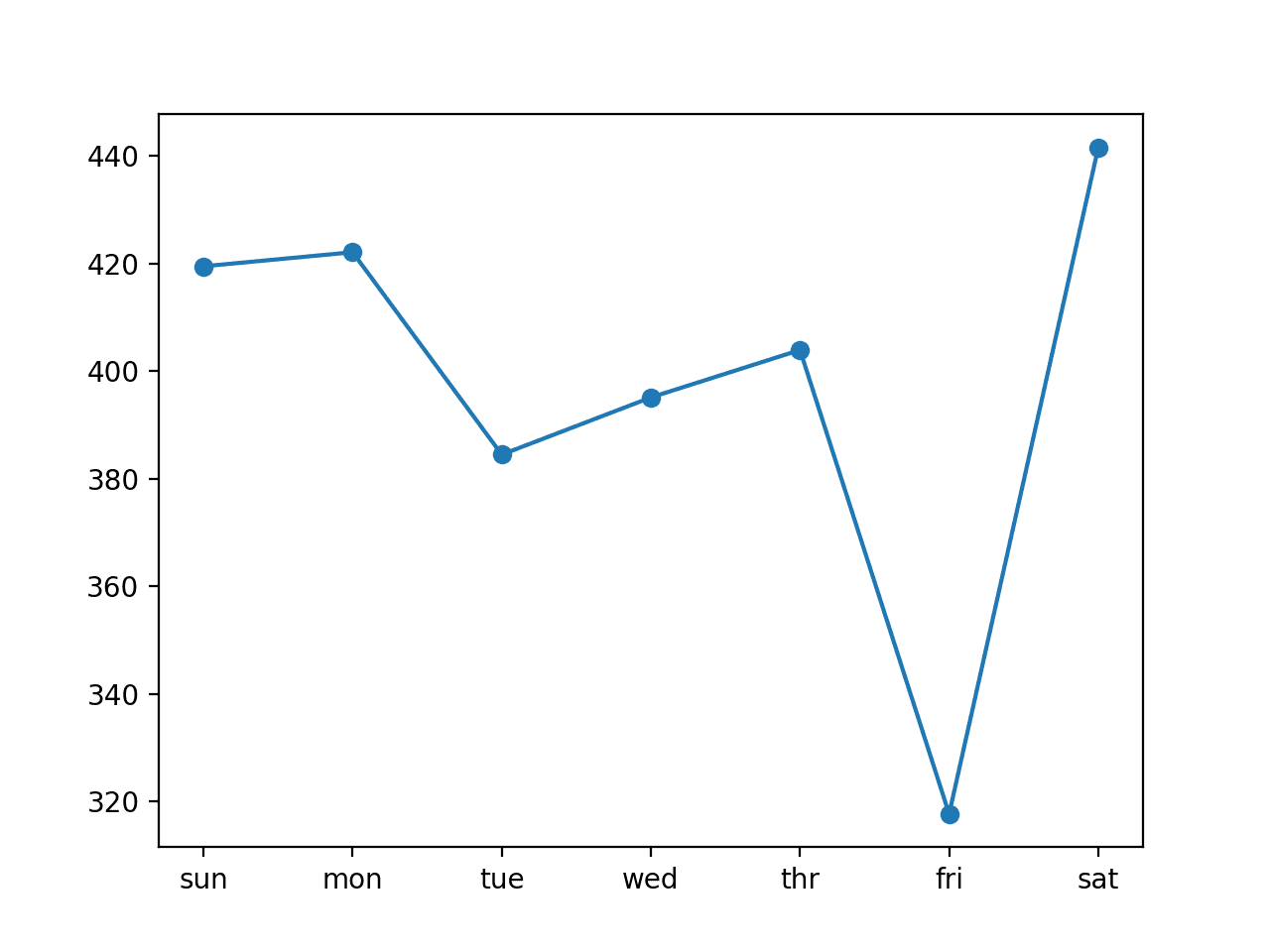
| 1 2 | # evaluate model and get scores n_input = 14 |
| 1 | lstm: [370.028] 387.4, 377.9, 334.0, 371.2, 367.1, 330.4, 415.1 |
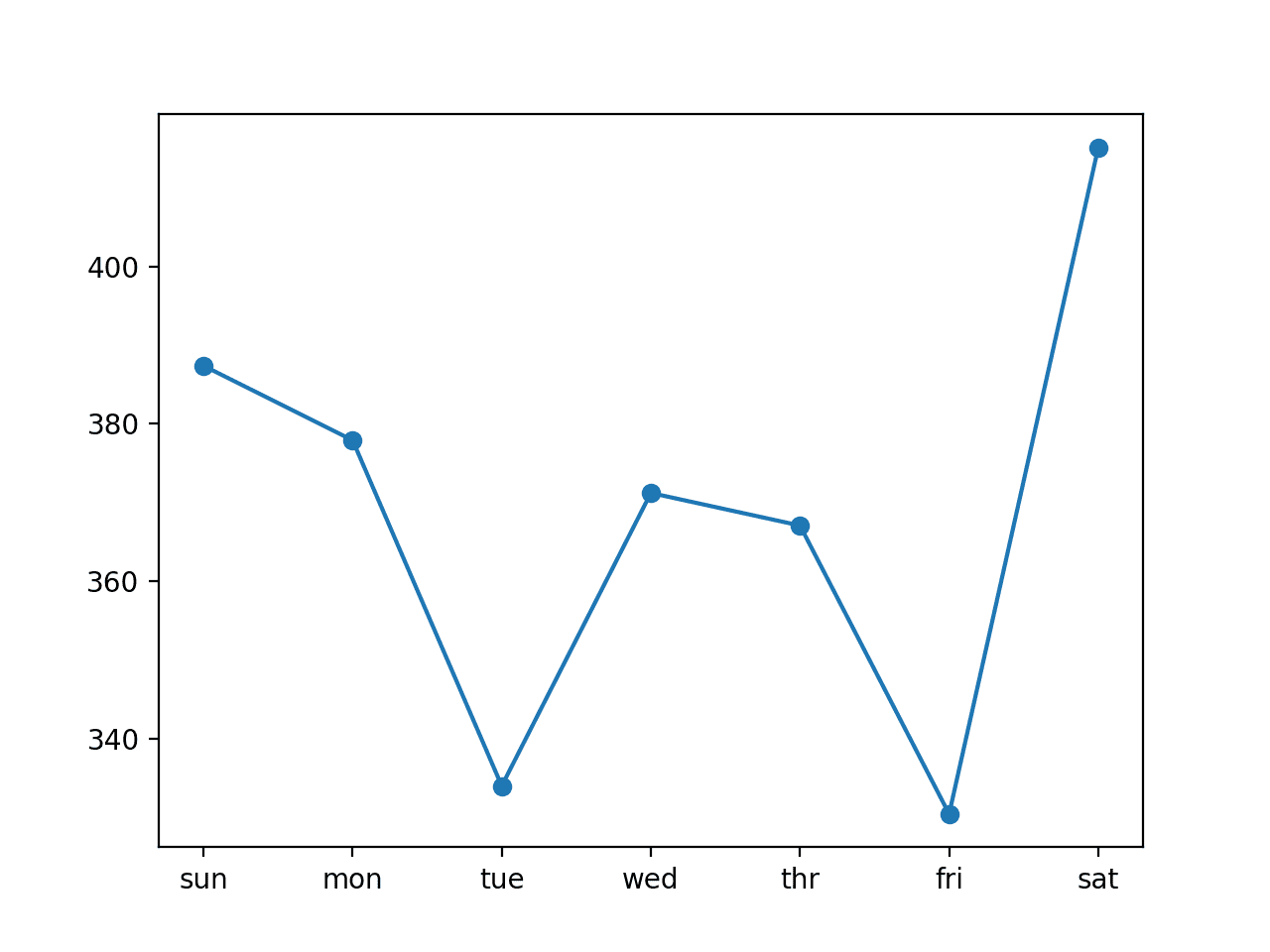
| 1 2 3 | # define model model = Sequential() model.add(LSTM(200, activation='relu', input_shape=(n_timesteps, n_features))) |
| 1 | model.add(RepeatVector(7)) |
| 1 | model.add(LSTM(200, activation='relu', return_sequences=True)) |
| 1 2 | model.add(TimeDistributed(Dense(100, activation='relu'))) model.add(TimeDistributed(Dense(1))) |
| 1 2 | # reshape output into [samples, timesteps, features] train_y = train_y.reshape((train_y.shape[0], train_y.shape[1], 1)) |
| 1 2 3 4 5 6 7 8 9 10 11 12 13 14 15 16 17 18 19 20 | # train the model def build_model(train, n_input): # prepare data train_x, train_y = to_supervised(train, n_input) # define parameters verbose, epochs, batch_size = 0, 20, 16 n_timesteps, n_features, n_outputs = train_x.shape[1], train_x.shape[2], train_y.shape[1] # reshape output into [samples, timesteps, features] train_y = train_y.reshape((train_y.shape[0], train_y.shape[1], 1)) # define model model = Sequential() model.add(LSTM(200, activation='relu', input_shape=(n_timesteps, n_features))) model.add(RepeatVector(n_outputs)) model.add(LSTM(200, activation='relu', return_sequences=True)) model.add(TimeDistributed(Dense(100, activation='relu'))) model.add(TimeDistributed(Dense(1))) model.compile(loss=mse, optimizer='adam') # fit network model.fit(train_x, train_y, epochs=epochs, batch_size=batch_size, verbose=verbose) return model |
| 1 2 3 4 5 6 7 8 9 10 11 12 13 14 15 16 17 18 19 20 21 22 23 24 25 26 27 28 29 30 31 32 33 34 35 36 37 38 39 40 41 42 43 44 45 46 47 48 49 50 51 52 53 54 55 56 57 58 59 60 61 62 63 64 65 66 67 68 69 70 71 72 73 74 75 76 77 78 79 80 81 82 83 84 85 86 87 88 89 90 91 92 93 94 95 96 97 98 99 100 101 102 103 104 105 106 107 108 109 110 111 112 113 114 115 116 117 118 119 120 121 122 123 124 125 126 127 128 129 130 131 132 133 134 135 136 137 | # univariate multi-step encoder-decoder lstm from math import sqrt from numpy import split from numpy import array from pandas import read_csv from sklearn.metrics import mean_squared_error from matplotlib import pyplot from keras.models import Sequential from keras.layers import Dense from keras.layers import Flatten from keras.layers import LSTM from keras.layers import RepeatVector from keras.layers import TimeDistributed # split a univariate dataset into train/test sets def split_dataset(data): # split into standard weeks train, test = data[1:-328], data[-328:-6] # restructure into windows of weekly data train = array(split(train, len(train)/7)) test = array(split(test, len(test)/7)) return train, test # evaluate one or more weekly forecasts against expected values def evaluate_forecasts(actual, predicted): scores = list() # calculate an RMSE score for each day for i in range(actual.shape[1]): # calculate mse mse = mean_squared_error(actual[:, i], predicted[:, i]) # calculate rmse rmse = sqrt(mse) # store scores.append(rmse) # calculate overall RMSE s = 0 for row in range(actual.shape[0]): for col in range(actual.shape[1]): s += (actual[row, col] - predicted[row, col])**2 score = sqrt(s / (actual.shape[0] * actual.shape[1])) return score, scores # summarize scores def summarize_scores(name, score, scores): s_scores = ', '.join(['%.1f' % s for s in scores]) print('%s: [%.3f] %s' % (name, score, s_scores)) # convert history into inputs and outputs def to_supervised(train, n_input, n_out=7): # flatten data data = train.reshape((train.shape[0]*train.shape[1], train.shape[2])) X, y = list(), list() in_start = 0 # step over the entire history one time step at a time for _ in range(len(data)): # define the end of the input sequence in_end = in_start + n_input out_end = in_end + n_out # ensure we have enough data for this instance if out_end < len(data): x_input = data[in_start:in_end, 0] x_input = x_input.reshape((len(x_input), 1)) X.append(x_input) y.append(data[in_end:out_end, 0]) # move along one time step in_start += 1 return array(X), array(y) # train the model def build_model(train, n_input): # prepare data train_x, train_y = to_supervised(train, n_input) # define parameters verbose, epochs, batch_size = 0, 20, 16 n_timesteps, n_features, n_outputs = train_x.shape[1], train_x.shape[2], train_y.shape[1] # reshape output into [samples, timesteps, features] train_y = train_y.reshape((train_y.shape[0], train_y.shape[1], 1)) # define model model = Sequential() model.add(LSTM(200, activation='relu', input_shape=(n_timesteps, n_features))) model.add(RepeatVector(n_outputs)) model.add(LSTM(200, activation='relu', return_sequences=True)) model.add(TimeDistributed(Dense(100, activation='relu'))) model.add(TimeDistributed(Dense(1))) model.compile(loss='mse', optimizer='adam') # fit network model.fit(train_x, train_y, epochs=epochs, batch_size=batch_size, verbose=verbose) return model # make a forecast def forecast(model, history, n_input): # flatten data data = array(history) data = data.reshape((data.shape[0]*data.shape[1], data.shape[2])) # retrieve last observations for input data input_x = data[-n_input:, 0] # reshape into [1, n_input, 1] input_x = input_x.reshape((1, len(input_x), 1)) # forecast the next week yhat = model.predict(input_x, verbose=0) # we only want the vector forecast yhat = yhat[0] return yhat # evaluate a single model def evaluate_model(train, test, n_input): # fit model model = build_model(train, n_input) # history is a list of weekly data history = [x for x in train] # walk-forward validation over each week predictions = list() for i in range(len(test)): # predict the week yhat_sequence = forecast(model, history, n_input) # store the predictions predictions.append(yhat_sequence) # get real observation and add to history for predicting the next week history.append(test[i, :]) # evaluate predictions days for each week predictions = array(predictions) score, scores = evaluate_forecasts(test[:, :, 0], predictions) return score, scores # load the new file dataset = read_csv('household_power_consumption_days.csv', header=0, infer_datetime_format=True, parse_dates=['datetime'], index_col=['datetime']) # split into train and test train, test = split_dataset(dataset.values) # evaluate model and get scores n_input = 14 score, scores = evaluate_model(train, test, n_input) # summarize scores summarize_scores('lstm', score, scores) # plot scores days = ['sun', 'mon', 'tue', 'wed', 'thr', 'fri', 'sat'] pyplot.plot(days, scores, marker='o', label='lstm') pyplot.show() |
| 1 | lstm: [372.595] 379.5, 399.8, 339.6, 372.2, 370.9, 309.9, 424.8 |
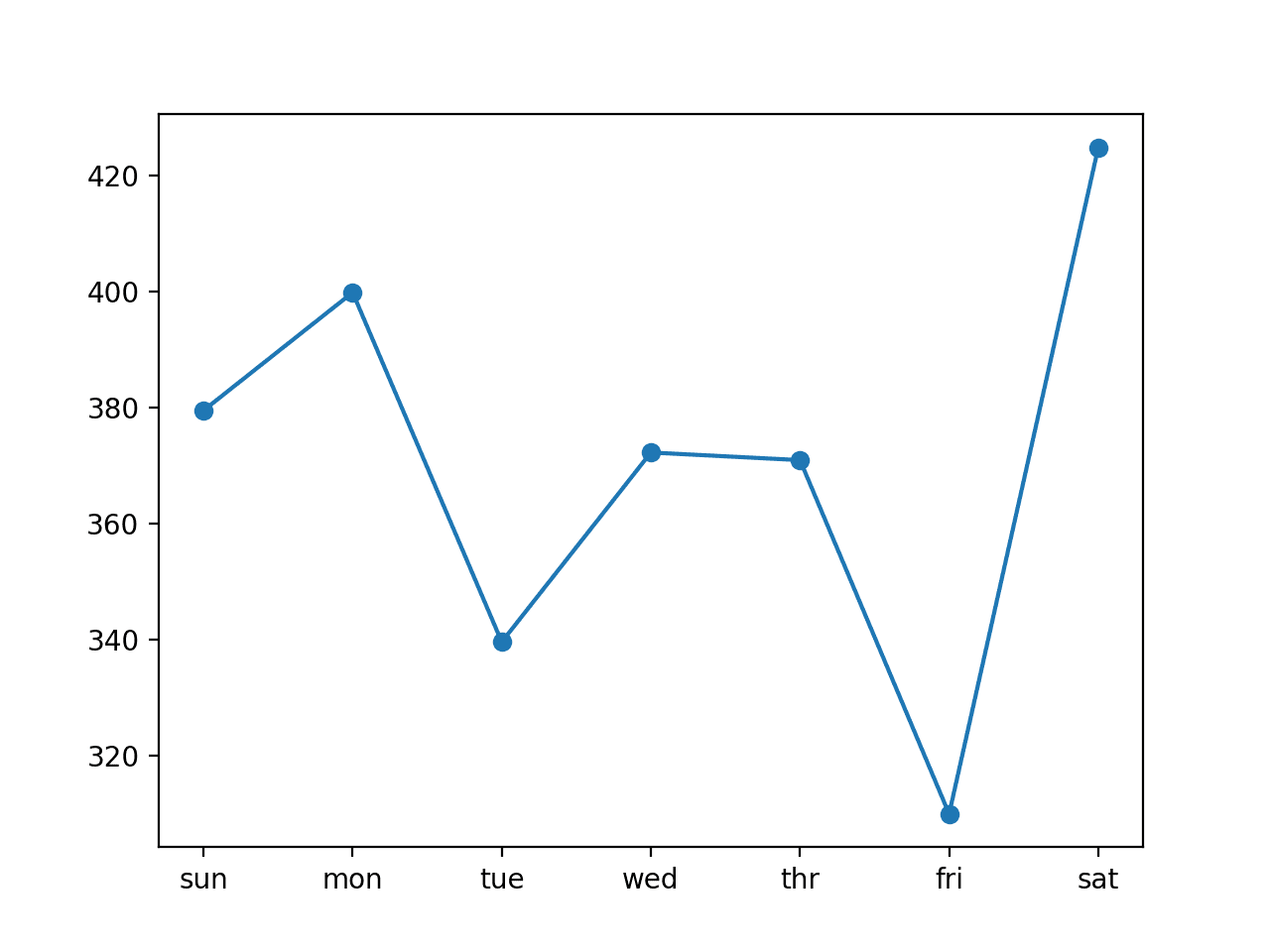
| 1 | X.append(data[in_start:in_end, :]) |
| 1 2 3 4 5 6 7 8 9 10 11 12 13 14 15 16 17 18 | # convert history into inputs and outputs def to_supervised(train, n_input, n_out=7): # flatten data data = train.reshape((train.shape[0]*train.shape[1], train.shape[2])) X, y = list(), list() in_start = 0 # step over the entire history one time step at a time for _ in range(len(data)): # define the end of the input sequence in_end = in_start + n_input out_end = in_end + n_out # ensure we have enough data for this instance if out_end < len(data): X.append(data[in_start:in_end, :]) y.append(data[in_end:out_end, 0]) # move along one time step in_start += 1 return array(X), array(y) |
| 1 2 3 4 | # retrieve last observations for input data input_x = data[-n_input:, :] # reshape into [1, n_input, n] input_x = input_x.reshape((1, input_x.shape[0], input_x.shape[1])) |
| 1 2 3 4 5 6 7 8 9 10 11 12 13 14 | # make a forecast def forecast(model, history, n_input): # flatten data data = array(history) data = data.reshape((data.shape[0]*data.shape[1], data.shape[2])) # retrieve last observations for input data input_x = data[-n_input:, :] # reshape into [1, n_input, n] input_x = input_x.reshape((1, input_x.shape[0], input_x.shape[1])) # forecast the next week yhat = model.predict(input_x, verbose=0) # we only want the vector forecast yhat = yhat[0] return yhat |
| 1 2 3 4 5 6 7 8 9 10 11 12 13 14 15 16 17 18 19 20 21 22 23 24 25 26 27 28 29 30 31 32 33 34 35 36 37 38 39 40 41 42 43 44 45 46 47 48 49 50 51 52 53 54 55 56 57 58 59 60 61 62 63 64 65 66 67 68 69 70 71 72 73 74 75 76 77 78 79 80 81 82 83 84 85 86 87 88 89 90 91 92 93 94 95 96 97 98 99 100 101 102 103 104 105 106 107 108 109 110 111 112 113 114 115 116 117 118 119 120 121 122 123 124 125 126 127 128 129 130 131 132 133 134 135 | # multivariate multi-step encoder-decoder lstm from math import sqrt from numpy import split from numpy import array from pandas import read_csv from sklearn.metrics import mean_squared_error from matplotlib import pyplot from keras.models import Sequential from keras.layers import Dense from keras.layers import Flatten from keras.layers import LSTM from keras.layers import RepeatVector from keras.layers import TimeDistributed # split a univariate dataset into train/test sets def split_dataset(data): # split into standard weeks train, test = data[1:-328], data[-328:-6] # restructure into windows of weekly data train = array(split(train, len(train)/7)) test = array(split(test, len(test)/7)) return train, test # evaluate one or more weekly forecasts against expected values def evaluate_forecasts(actual, predicted): scores = list() # calculate an RMSE score for each day for i in range(actual.shape[1]): # calculate mse mse = mean_squared_error(actual[:, i], predicted[:, i]) # calculate rmse rmse = sqrt(mse) # store scores.append(rmse) # calculate overall RMSE s = 0 for row in range(actual.shape[0]): for col in range(actual.shape[1]): s += (actual[row, col] - predicted[row, col])**2 score = sqrt(s / (actual.shape[0] * actual.shape[1])) return score, scores # summarize scores def summarize_scores(name, score, scores): s_scores = ', '.join(['%.1f' % s for s in scores]) print('%s: [%.3f] %s' % (name, score, s_scores)) # convert history into inputs and outputs def to_supervised(train, n_input, n_out=7): # flatten data data = train.reshape((train.shape[0]*train.shape[1], train.shape[2])) X, y = list(), list() in_start = 0 # step over the entire history one time step at a time for _ in range(len(data)): # define the end of the input sequence in_end = in_start + n_input out_end = in_end + n_out # ensure we have enough data for this instance if out_end < len(data): X.append(data[in_start:in_end, :]) y.append(data[in_end:out_end, 0]) # move along one time step in_start += 1 return array(X), array(y) # train the model def build_model(train, n_input): # prepare data train_x, train_y = to_supervised(train, n_input) # define parameters verbose, epochs, batch_size = 0, 50, 16 n_timesteps, n_features, n_outputs = train_x.shape[1], train_x.shape[2], train_y.shape[1] # reshape output into [samples, timesteps, features] train_y = train_y.reshape((train_y.shape[0], train_y.shape[1], 1)) # define model model = Sequential() model.add(LSTM(200, activation='relu', input_shape=(n_timesteps, n_features))) model.add(RepeatVector(n_outputs)) model.add(LSTM(200, activation='relu', return_sequences=True)) model.add(TimeDistributed(Dense(100, activation='relu'))) model.add(TimeDistributed(Dense(1))) model.compile(loss='mse', optimizer='adam') # fit network model.fit(train_x, train_y, epochs=epochs, batch_size=batch_size, verbose=verbose) return model # make a forecast def forecast(model, history, n_input): # flatten data data = array(history) data = data.reshape((data.shape[0]*data.shape[1], data.shape[2])) # retrieve last observations for input data input_x = data[-n_input:, :] # reshape into [1, n_input, n] input_x = input_x.reshape((1, input_x.shape[0], input_x.shape[1])) # forecast the next week yhat = model.predict(input_x, verbose=0) # we only want the vector forecast yhat = yhat[0] return yhat # evaluate a single model def evaluate_model(train, test, n_input): # fit model model = build_model(train, n_input) # history is a list of weekly data history = [x for x in train] # walk-forward validation over each week predictions = list() for i in range(len(test)): # predict the week yhat_sequence = forecast(model, history, n_input) # store the predictions predictions.append(yhat_sequence) # get real observation and add to history for predicting the next week history.append(test[i, :]) # evaluate predictions days for each week predictions = array(predictions) score, scores = evaluate_forecasts(test[:, :, 0], predictions) return score, scores # load the new file dataset = read_csv('household_power_consumption_days.csv', header=0, infer_datetime_format=True, parse_dates=['datetime'], index_col=['datetime']) # split into train and test train, test = split_dataset(dataset.values) # evaluate model and get scores n_input = 14 score, scores = evaluate_model(train, test, n_input) # summarize scores summarize_scores('lstm', score, scores) # plot scores days = ['sun', 'mon', 'tue', 'wed', 'thr', 'fri', 'sat'] pyplot.plot(days, scores, marker='o', label='lstm') pyplot.show() |
| 1 | lstm: [376.273] 378.5, 381.5, 328.4, 388.3, 361.2, 308.0, 467.2 |
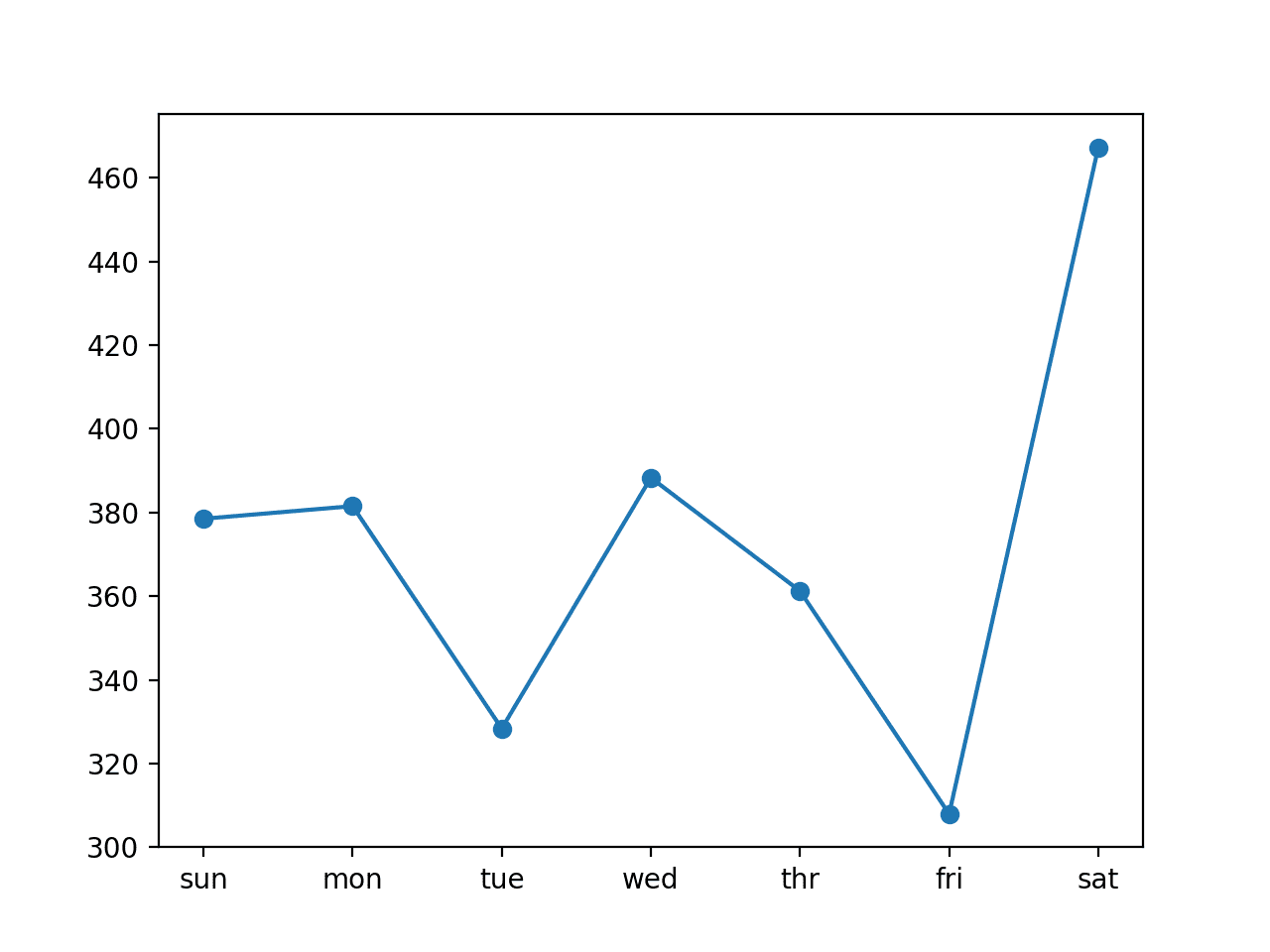
| 1 2 | # load all data dataset = read_csv('household_power_consumption.txt', sep=';', header=0, low_memory=False, infer_datetime_format=True, parse_dates={'datetime':[0,1]}, index_col=['datetime']) |
| 1 2 3 4 | # mark all missing values dataset.replace('?', nan, inplace=True) # make dataset numeric dataset = dataset.astype('float32') |
| 1 2 3 4 5 6 7 | # fill missing values with a value at the same time one day ago def fill_missing(values): one_day = 60 * 24 for row in range(values.shape[0]): for col in range(values.shape[1]): if isnan(values[row, col]): values[row, col] = values[row - one_day, col] |
| 1 2 | # fill missing fill_missing(dataset.values) |
| 1 2 3 | # add a column for for the remainder of sub metering values = dataset.values dataset['sub_metering_4'] = (values[:,0] * 1000 / 60) - (values[:,4] + values[:,5] + values[:,6]) |
| 1 2 | # save updated dataset dataset.to_csv('household_power_consumption.csv') |
| 1 2 3 4 5 6 7 8 9 10 11 12 13 14 15 16 17 18 19 20 21 22 23 24 25 26 27 | # load and clean-up data from numpy import nan from numpy import isnan from pandas import read_csv from pandas import to_numeric # fill missing values with a value at the same time one day ago def fill_missing(values): one_day = 60 * 24 for row in range(values.shape[0]): for col in range(values.shape[1]): if isnan(values[row, col]): values[row, col] = values[row - one_day, col] # load all data dataset = read_csv('household_power_consumption.txt', sep=';', header=0, low_memory=False, infer_datetime_format=True, parse_dates={'datetime':[0,1]}, index_col=['datetime']) # mark all missing values dataset.replace('?', nan, inplace=True) # make dataset numeric dataset = dataset.astype('float32') # fill missing fill_missing(dataset.values) # add a column for for the remainder of sub metering values = dataset.values dataset['sub_metering_4'] = (values[:,0] * 1000 / 60) - (values[:,4] + values[:,5] + values[:,6]) # save updated dataset dataset.to_csv('household_power_consumption.csv') |
| 1 2 3 4 5 6 7 8 9 10 11 12 | # resample minute data to total for each day from pandas import read_csv # load the new file dataset = read_csv('household_power_consumption.csv', header=0, infer_datetime_format=True, parse_dates=['datetime'], index_col=['datetime']) # resample data to daily daily_groups = dataset.resample('D') daily_data = daily_groups.sum() # summarize print(daily_data.shape) print(daily_data.head()) # save daily_data.to_csv('household_power_consumption_days.csv') |
| 1 2 3 4 5 6 7 8 9 10 11 12 13 14 15 16 17 18 | # evaluate one or more weekly forecasts against expected values def evaluate_forecasts(actual, predicted): scores = list() # calculate an RMSE score for each day for i in range(actual.shape[1]): # calculate mse mse = mean_squared_error(actual[:, i], predicted[:, i]) # calculate rmse rmse = sqrt(mse) # store scores.append(rmse) # calculate overall RMSE s = 0 for row in range(actual.shape[0]): for col in range(actual.shape[1]): s += (actual[row, col] - predicted[row, col])**2 score = sqrt(s / (actual.shape[0] * actual.shape[1])) return score, scores |
| 1 2 3 | 2010-01-03,2083.4539999999984,191.61000000000055,350992.12000000034,8703.600000000033,3842.0,4920.0,10074.0,15888.233355799992 ... 2010-11-20,2197.006000000004,153.76800000000028,346475.9999999998,9320.20000000002,4367.0,2947.0,11433.0,17869.76663959999 |
| 1 2 3 | 2006-12-17,3390.46,226.0059999999994,345725.32000000024,14398.59999999998,2033.0,4187.0,13341.0,36946.66673200004 ... 2010-01-02,1309.2679999999998,199.54600000000016,352332.8399999997,5489.7999999999865,801.0,298.0,6425.0,14297.133406600002 |
| 1 2 3 4 5 6 7 8 | # split a univariate dataset into train/test sets def split_dataset(data): # split into standard weeks train, test = data[1:-328], data[-328:-6] # restructure into windows of weekly data train = array(split(train, len(train)/7)) test = array(split(test, len(test)/7)) return train, test |
| 1 2 3 4 5 6 7 8 9 10 11 12 13 14 15 16 17 18 19 20 21 22 23 | # split into standard weeks from numpy import split from numpy import array from pandas import read_csv # split a univariate dataset into train/test sets def split_dataset(data): # split into standard weeks train, test = data[1:-328], data[-328:-6] # restructure into windows of weekly data train = array(split(train, len(train)/7)) test = array(split(test, len(test)/7)) return train, test # load the new file dataset = read_csv('household_power_consumption_days.csv', header=0, infer_datetime_format=True, parse_dates=['datetime'], index_col=['datetime']) train, test = split_dataset(dataset.values) # validate train data print(train.shape) print(train[0, 0, 0], train[-1, -1, 0]) # validate test print(test.shape) print(test[0, 0, 0], test[-1, -1, 0]) |
| 1 2 3 4 | (159, 7, 8) 3390.46 1309.2679999999998 (46, 7, 8) 2083.4539999999984 2197.006000000004 |
| 1 2 3 4 5 | Input, Predict [Week1] Week2 [Week1 + Week2] Week3 [Week1 + Week2 + Week3] Week4 ... |
| 1 2 3 4 5 6 7 8 9 10 11 12 13 14 15 16 17 18 19 | # evaluate a single model def evaluate_model(train, test, n_input): # fit model model = build_model(train, n_input) # history is a list of weekly data history = [x for x in train] # walk-forward validation over each week predictions = list() for i in range(len(test)): # predict the week yhat_sequence = forecast(model, history, n_input) # store the predictions predictions.append(yhat_sequence) # get real observation and add to history for predicting the next week history.append(test[i, :]) # evaluate predictions days for each week predictions = array(predictions) score, scores = evaluate_forecasts(test[:, :, 0], predictions) return score, scores |
| 1 2 3 4 | # summarize scores def summarize_scores(name, score, scores): s_scores = ', '.join(['%.1f' % s for s in scores]) print('%s: [%.3f] %s' % (name, score, s_scores)) |
| 1 | [samples, timesteps, features] |
| 1 | [159, 7, 1] |
| 1 2 | # flatten data data = train.reshape((train.shape[0]*train.shape[1], train.shape[2])) |
| 1 2 3 4 | Input, Output [d01, d02, d03, d04, d05, d06, d07], [d08, d09, d10, d11, d12, d13, d14] [d02, d03, d04, d05, d06, d07, d08], [d09, d10, d11, d12, d13, d14, d15] ... |
| 1 2 3 4 5 6 7 8 9 10 11 12 13 14 15 16 17 18 19 20 | # convert history into inputs and outputs def to_supervised(train, n_input, n_out=7): # flatten data data = train.reshape((train.shape[0]*train.shape[1], train.shape[2])) X, y = list(), list() in_start = 0 # step over the entire history one time step at a time for _ in range(len(data)): # define the end of the input sequence in_end = in_start + n_input out_end = in_end + n_out # ensure we have enough data for this instance if out_end < len(data): x_input = data[in_start:in_end, 0] x_input = x_input.reshape((len(x_input), 1)) X.append(x_input) y.append(data[in_end:out_end, 0]) # move along one time step in_start += 1 return array(X), array(y) |
| 1 2 3 4 5 6 7 8 9 10 11 12 13 14 15 16 | # train the model def build_model(train, n_input): # prepare data train_x, train_y = to_supervised(train, n_input) # define parameters verbose, epochs, batch_size = 0, 70, 16 n_timesteps, n_features, n_outputs = train_x.shape[1], train_x.shape[2], train_y.shape[1] # define model model = Sequential() model.add(LSTM(200, activation='relu', input_shape=(n_timesteps, n_features))) model.add(Dense(100, activation='relu')) model.add(Dense(n_outputs)) model.compile(loss='mse', optimizer='adam') # fit network model.fit(train_x, train_y, epochs=epochs, batch_size=batch_size, verbose=verbose) return model |
| 1 | [1, 7, 1] |
| 1 2 | # flatten data data = data.reshape((data.shape[0]*data.shape[1], data.shape[2])) |
| 1 2 | # retrieve last observations for input data input_x = data[-n_input:, 0] |
| 1 2 | # reshape into [1, n_input, 1] input_x = input_x.reshape((1, len(input_x), 1)) |
| 1 2 3 4 | # forecast the next week yhat = model.predict(input_x, verbose=0) # we only want the vector forecast yhat = yhat[0] |
| 1 2 3 4 5 6 7 8 9 10 11 12 13 14 | # make a forecast def forecast(model, history, n_input): # flatten data data = array(history) data = data.reshape((data.shape[0]*data.shape[1], data.shape[2])) # retrieve last observations for input data input_x = data[-n_input:, 0] # reshape into [1, n_input, 1] input_x = input_x.reshape((1, len(input_x), 1)) # forecast the next week yhat = model.predict(input_x, verbose=0) # we only want the vector forecast yhat = yhat[0] return yhat |
| 1 2 3 4 5 6 7 8 9 10 11 12 13 14 15 16 17 18 19 20 21 22 23 24 25 26 27 28 29 30 31 32 33 34 35 36 37 38 39 40 41 42 43 44 45 46 47 48 49 50 51 52 53 54 55 56 57 58 59 60 61 62 63 64 65 66 67 68 69 70 71 72 73 74 75 76 77 78 79 80 81 82 83 84 85 86 87 88 89 90 91 92 93 94 95 96 97 98 99 100 101 102 103 104 105 106 107 108 109 110 111 112 113 114 115 116 117 118 119 120 121 122 123 124 125 126 127 128 129 130 131 | # univariate multi-step lstm from math import sqrt from numpy import split from numpy import array from pandas import read_csv from sklearn.metrics import mean_squared_error from matplotlib import pyplot from keras.models import Sequential from keras.layers import Dense from keras.layers import Flatten from keras.layers import LSTM # split a univariate dataset into train/test sets def split_dataset(data): # split into standard weeks train, test = data[1:-328], data[-328:-6] # restructure into windows of weekly data train = array(split(train, len(train)/7)) test = array(split(test, len(test)/7)) return train, test # evaluate one or more weekly forecasts against expected values def evaluate_forecasts(actual, predicted): scores = list() # calculate an RMSE score for each day for i in range(actual.shape[1]): # calculate mse mse = mean_squared_error(actual[:, i], predicted[:, i]) # calculate rmse rmse = sqrt(mse) # store scores.append(rmse) # calculate overall RMSE s = 0 for row in range(actual.shape[0]): for col in range(actual.shape[1]): s += (actual[row, col] - predicted[row, col])**2 score = sqrt(s / (actual.shape[0] * actual.shape[1])) return score, scores # summarize scores def summarize_scores(name, score, scores): s_scores = ', '.join(['%.1f' % s for s in scores]) print('%s: [%.3f] %s' % (name, score, s_scores)) # convert history into inputs and outputs def to_supervised(train, n_input, n_out=7): # flatten data data = train.reshape((train.shape[0]*train.shape[1], train.shape[2])) X, y = list(), list() in_start = 0 # step over the entire history one time step at a time for _ in range(len(data)): # define the end of the input sequence in_end = in_start + n_input out_end = in_end + n_out # ensure we have enough data for this instance if out_end < len(data): x_input = data[in_start:in_end, 0] x_input = x_input.reshape((len(x_input), 1)) X.append(x_input) y.append(data[in_end:out_end, 0]) # move along one time step in_start += 1 return array(X), array(y) # train the model def build_model(train, n_input): # prepare data train_x, train_y = to_supervised(train, n_input) # define parameters verbose, epochs, batch_size = 0, 70, 16 n_timesteps, n_features, n_outputs = train_x.shape[1], train_x.shape[2], train_y.shape[1] # define model model = Sequential() model.add(LSTM(200, activation='relu', input_shape=(n_timesteps, n_features))) model.add(Dense(100, activation='relu')) model.add(Dense(n_outputs)) model.compile(loss='mse', optimizer='adam') # fit network model.fit(train_x, train_y, epochs=epochs, batch_size=batch_size, verbose=verbose) return model # make a forecast def forecast(model, history, n_input): # flatten data data = array(history) data = data.reshape((data.shape[0]*data.shape[1], data.shape[2])) # retrieve last observations for input data input_x = data[-n_input:, 0] # reshape into [1, n_input, 1] input_x = input_x.reshape((1, len(input_x), 1)) # forecast the next week yhat = model.predict(input_x, verbose=0) # we only want the vector forecast yhat = yhat[0] return yhat # evaluate a single model def evaluate_model(train, test, n_input): # fit model model = build_model(train, n_input) # history is a list of weekly data history = [x for x in train] # walk-forward validation over each week predictions = list() for i in range(len(test)): # predict the week yhat_sequence = forecast(model, history, n_input) # store the predictions predictions.append(yhat_sequence) # get real observation and add to history for predicting the next week history.append(test[i, :]) # evaluate predictions days for each week predictions = array(predictions) score, scores = evaluate_forecasts(test[:, :, 0], predictions) return score, scores # load the new file dataset = read_csv('household_power_consumption_days.csv', header=0, infer_datetime_format=True, parse_dates=['datetime'], index_col=['datetime']) # split into train and test train, test = split_dataset(dataset.values) # evaluate model and get scores n_input = 7 score, scores = evaluate_model(train, test, n_input) # summarize scores summarize_scores('lstm', score, scores) # plot scores days = ['sun', 'mon', 'tue', 'wed', 'thr', 'fri', 'sat'] pyplot.plot(days, scores, marker='o', label='lstm') pyplot.show() |
| 1 | lstm: [399.456] 419.4, 422.1, 384.5, 395.1, 403.9, 317.7, 441.5 |
| 1 2 | # evaluate model and get scores n_input = 14 |
| 1 | lstm: [370.028] 387.4, 377.9, 334.0, 371.2, 367.1, 330.4, 415.1 |
| 1 2 3 | # define model model = Sequential() model.add(LSTM(200, activation='relu', input_shape=(n_timesteps, n_features))) |
| 1 | model.add(RepeatVector(7)) |
| 1 | model.add(LSTM(200, activation='relu', return_sequences=True)) |
| 1 2 | model.add(TimeDistributed(Dense(100, activation='relu'))) model.add(TimeDistributed(Dense(1))) |
| 1 2 | # reshape output into [samples, timesteps, features] train_y = train_y.reshape((train_y.shape[0], train_y.shape[1], 1)) |
| 1 2 3 4 5 6 7 8 9 10 11 12 13 14 15 16 17 18 19 20 | # train the model def build_model(train, n_input): # prepare data train_x, train_y = to_supervised(train, n_input) # define parameters verbose, epochs, batch_size = 0, 20, 16 n_timesteps, n_features, n_outputs = train_x.shape[1], train_x.shape[2], train_y.shape[1] # reshape output into [samples, timesteps, features] train_y = train_y.reshape((train_y.shape[0], train_y.shape[1], 1)) # define model model = Sequential() model.add(LSTM(200, activation='relu', input_shape=(n_timesteps, n_features))) model.add(RepeatVector(n_outputs)) model.add(LSTM(200, activation='relu', return_sequences=True)) model.add(TimeDistributed(Dense(100, activation='relu'))) model.add(TimeDistributed(Dense(1))) model.compile(loss=mse, optimizer='adam') # fit network model.fit(train_x, train_y, epochs=epochs, batch_size=batch_size, verbose=verbose) return model |
| 1 2 3 4 5 6 7 8 9 10 11 12 13 14 15 16 17 18 19 20 21 22 23 24 25 26 27 28 29 30 31 32 33 34 35 36 37 38 39 40 41 42 43 44 45 46 47 48 49 50 51 52 53 54 55 56 57 58 59 60 61 62 63 64 65 66 67 68 69 70 71 72 73 74 75 76 77 78 79 80 81 82 83 84 85 86 87 88 89 90 91 92 93 94 95 96 97 98 99 100 101 102 103 104 105 106 107 108 109 110 111 112 113 114 115 116 117 118 119 120 121 122 123 124 125 126 127 128 129 130 131 132 133 134 135 136 137 | # univariate multi-step encoder-decoder lstm from math import sqrt from numpy import split from numpy import array from pandas import read_csv from sklearn.metrics import mean_squared_error from matplotlib import pyplot from keras.models import Sequential from keras.layers import Dense from keras.layers import Flatten from keras.layers import LSTM from keras.layers import RepeatVector from keras.layers import TimeDistributed # split a univariate dataset into train/test sets def split_dataset(data): # split into standard weeks train, test = data[1:-328], data[-328:-6] # restructure into windows of weekly data train = array(split(train, len(train)/7)) test = array(split(test, len(test)/7)) return train, test # evaluate one or more weekly forecasts against expected values def evaluate_forecasts(actual, predicted): scores = list() # calculate an RMSE score for each day for i in range(actual.shape[1]): # calculate mse mse = mean_squared_error(actual[:, i], predicted[:, i]) # calculate rmse rmse = sqrt(mse) # store scores.append(rmse) # calculate overall RMSE s = 0 for row in range(actual.shape[0]): for col in range(actual.shape[1]): s += (actual[row, col] - predicted[row, col])**2 score = sqrt(s / (actual.shape[0] * actual.shape[1])) return score, scores # summarize scores def summarize_scores(name, score, scores): s_scores = ', '.join(['%.1f' % s for s in scores]) print('%s: [%.3f] %s' % (name, score, s_scores)) # convert history into inputs and outputs def to_supervised(train, n_input, n_out=7): # flatten data data = train.reshape((train.shape[0]*train.shape[1], train.shape[2])) X, y = list(), list() in_start = 0 # step over the entire history one time step at a time for _ in range(len(data)): # define the end of the input sequence in_end = in_start + n_input out_end = in_end + n_out # ensure we have enough data for this instance if out_end < len(data): x_input = data[in_start:in_end, 0] x_input = x_input.reshape((len(x_input), 1)) X.append(x_input) y.append(data[in_end:out_end, 0]) # move along one time step in_start += 1 return array(X), array(y) # train the model def build_model(train, n_input): # prepare data train_x, train_y = to_supervised(train, n_input) # define parameters verbose, epochs, batch_size = 0, 20, 16 n_timesteps, n_features, n_outputs = train_x.shape[1], train_x.shape[2], train_y.shape[1] # reshape output into [samples, timesteps, features] train_y = train_y.reshape((train_y.shape[0], train_y.shape[1], 1)) # define model model = Sequential() model.add(LSTM(200, activation='relu', input_shape=(n_timesteps, n_features))) model.add(RepeatVector(n_outputs)) model.add(LSTM(200, activation='relu', return_sequences=True)) model.add(TimeDistributed(Dense(100, activation='relu'))) model.add(TimeDistributed(Dense(1))) model.compile(loss='mse', optimizer='adam') # fit network model.fit(train_x, train_y, epochs=epochs, batch_size=batch_size, verbose=verbose) return model # make a forecast def forecast(model, history, n_input): # flatten data data = array(history) data = data.reshape((data.shape[0]*data.shape[1], data.shape[2])) # retrieve last observations for input data input_x = data[-n_input:, 0] # reshape into [1, n_input, 1] input_x = input_x.reshape((1, len(input_x), 1)) # forecast the next week yhat = model.predict(input_x, verbose=0) # we only want the vector forecast yhat = yhat[0] return yhat # evaluate a single model def evaluate_model(train, test, n_input): # fit model model = build_model(train, n_input) # history is a list of weekly data history = [x for x in train] # walk-forward validation over each week predictions = list() for i in range(len(test)): # predict the week yhat_sequence = forecast(model, history, n_input) # store the predictions predictions.append(yhat_sequence) # get real observation and add to history for predicting the next week history.append(test[i, :]) # evaluate predictions days for each week predictions = array(predictions) score, scores = evaluate_forecasts(test[:, :, 0], predictions) return score, scores # load the new file dataset = read_csv('household_power_consumption_days.csv', header=0, infer_datetime_format=True, parse_dates=['datetime'], index_col=['datetime']) # split into train and test train, test = split_dataset(dataset.values) # evaluate model and get scores n_input = 14 score, scores = evaluate_model(train, test, n_input) # summarize scores summarize_scores('lstm', score, scores) # plot scores days = ['sun', 'mon', 'tue', 'wed', 'thr', 'fri', 'sat'] pyplot.plot(days, scores, marker='o', label='lstm') pyplot.show() |
| 1 | lstm: [372.595] 379.5, 399.8, 339.6, 372.2, 370.9, 309.9, 424.8 |
| 1 | X.append(data[in_start:in_end, :]) |
| 1 2 3 4 5 6 7 8 9 10 11 12 13 14 15 16 17 18 | # convert history into inputs and outputs def to_supervised(train, n_input, n_out=7): # flatten data data = train.reshape((train.shape[0]*train.shape[1], train.shape[2])) X, y = list(), list() in_start = 0 # step over the entire history one time step at a time for _ in range(len(data)): # define the end of the input sequence in_end = in_start + n_input out_end = in_end + n_out # ensure we have enough data for this instance if out_end < len(data): X.append(data[in_start:in_end, :]) y.append(data[in_end:out_end, 0]) # move along one time step in_start += 1 return array(X), array(y) |
| 1 2 3 4 | # retrieve last observations for input data input_x = data[-n_input:, :] # reshape into [1, n_input, n] input_x = input_x.reshape((1, input_x.shape[0], input_x.shape[1])) |
| 1 2 3 4 5 6 7 8 9 10 11 12 13 14 | # make a forecast def forecast(model, history, n_input): # flatten data data = array(history) data = data.reshape((data.shape[0]*data.shape[1], data.shape[2])) # retrieve last observations for input data input_x = data[-n_input:, :] # reshape into [1, n_input, n] input_x = input_x.reshape((1, input_x.shape[0], input_x.shape[1])) # forecast the next week yhat = model.predict(input_x, verbose=0) # we only want the vector forecast yhat = yhat[0] return yhat |
| 1 2 3 4 5 6 7 8 9 10 11 12 13 14 15 16 17 18 19 20 21 22 23 24 25 26 27 28 29 30 31 32 33 34 35 36 37 38 39 40 41 42 43 44 45 46 47 48 49 50 51 52 53 54 55 56 57 58 59 60 61 62 63 64 65 66 67 68 69 70 71 72 73 74 75 76 77 78 79 80 81 82 83 84 85 86 87 88 89 90 91 92 93 94 95 96 97 98 99 100 101 102 103 104 105 106 107 108 109 110 111 112 113 114 115 116 117 118 119 120 121 122 123 124 125 126 127 128 129 130 131 132 133 134 135 | # multivariate multi-step encoder-decoder lstm from math import sqrt from numpy import split from numpy import array from pandas import read_csv from sklearn.metrics import mean_squared_error from matplotlib import pyplot from keras.models import Sequential from keras.layers import Dense from keras.layers import Flatten from keras.layers import LSTM from keras.layers import RepeatVector from keras.layers import TimeDistributed # split a univariate dataset into train/test sets def split_dataset(data): # split into standard weeks train, test = data[1:-328], data[-328:-6] # restructure into windows of weekly data train = array(split(train, len(train)/7)) test = array(split(test, len(test)/7)) return train, test # evaluate one or more weekly forecasts against expected values def evaluate_forecasts(actual, predicted): scores = list() # calculate an RMSE score for each day for i in range(actual.shape[1]): # calculate mse mse = mean_squared_error(actual[:, i], predicted[:, i]) # calculate rmse rmse = sqrt(mse) # store scores.append(rmse) # calculate overall RMSE s = 0 for row in range(actual.shape[0]): for col in range(actual.shape[1]): s += (actual[row, col] - predicted[row, col])**2 score = sqrt(s / (actual.shape[0] * actual.shape[1])) return score, scores # summarize scores def summarize_scores(name, score, scores): s_scores = ', '.join(['%.1f' % s for s in scores]) print('%s: [%.3f] %s' % (name, score, s_scores)) # convert history into inputs and outputs def to_supervised(train, n_input, n_out=7): # flatten data data = train.reshape((train.shape[0]*train.shape[1], train.shape[2])) X, y = list(), list() in_start = 0 # step over the entire history one time step at a time for _ in range(len(data)): # define the end of the input sequence in_end = in_start + n_input out_end = in_end + n_out # ensure we have enough data for this instance if out_end < len(data): X.append(data[in_start:in_end, :]) y.append(data[in_end:out_end, 0]) # move along one time step in_start += 1 return array(X), array(y) # train the model def build_model(train, n_input): # prepare data train_x, train_y = to_supervised(train, n_input) # define parameters verbose, epochs, batch_size = 0, 50, 16 n_timesteps, n_features, n_outputs = train_x.shape[1], train_x.shape[2], train_y.shape[1] # reshape output into [samples, timesteps, features] train_y = train_y.reshape((train_y.shape[0], train_y.shape[1], 1)) # define model model = Sequential() model.add(LSTM(200, activation='relu', input_shape=(n_timesteps, n_features))) model.add(RepeatVector(n_outputs)) model.add(LSTM(200, activation='relu', return_sequences=True)) model.add(TimeDistributed(Dense(100, activation='relu'))) model.add(TimeDistributed(Dense(1))) model.compile(loss='mse', optimizer='adam') # fit network model.fit(train_x, train_y, epochs=epochs, batch_size=batch_size, verbose=verbose) return model # make a forecast def forecast(model, history, n_input): # flatten data data = array(history) data = data.reshape((data.shape[0]*data.shape[1], data.shape[2])) # retrieve last observations for input data input_x = data[-n_input:, :] # reshape into [1, n_input, n] input_x = input_x.reshape((1, input_x.shape[0], input_x.shape[1])) # forecast the next week yhat = model.predict(input_x, verbose=0) # we only want the vector forecast yhat = yhat[0] return yhat # evaluate a single model def evaluate_model(train, test, n_input): # fit model model = build_model(train, n_input) # history is a list of weekly data history = [x for x in train] # walk-forward validation over each week predictions = list() for i in range(len(test)): # predict the week yhat_sequence = forecast(model, history, n_input) # store the predictions predictions.append(yhat_sequence) # get real observation and add to history for predicting the next week history.append(test[i, :]) # evaluate predictions days for each week predictions = array(predictions) score, scores = evaluate_forecasts(test[:, :, 0], predictions) return score, scores # load the new file dataset = read_csv('household_power_consumption_days.csv', header=0, infer_datetime_format=True, parse_dates=['datetime'], index_col=['datetime']) # split into train and test train, test = split_dataset(dataset.values) # evaluate model and get scores n_input = 14 score, scores = evaluate_model(train, test, n_input) # summarize scores summarize_scores('lstm', score, scores) # plot scores days = ['sun', 'mon', 'tue', 'wed', 'thr', 'fri', 'sat'] pyplot.plot(days, scores, marker='o', label='lstm') pyplot.show() |
| 1 | lstm: [376.273] 378.5, 381.5, 328.4, 388.3, 361.2, 308.0, 467.2 |

 举报
举报
更多回帖


