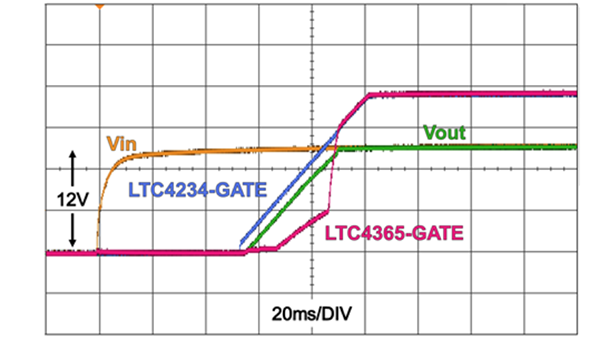
图 2:示波器波形结论
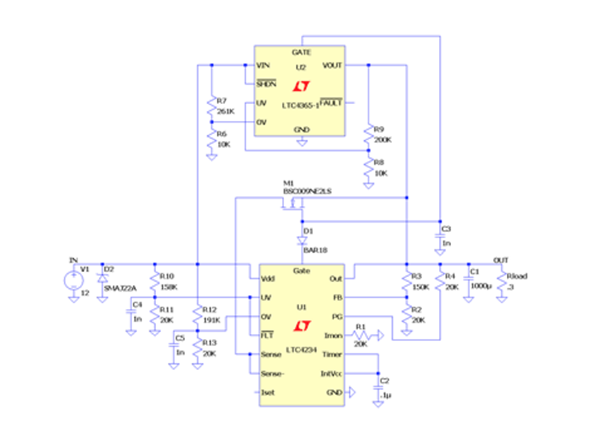
利用这种方法,我们可以做到两全其美。LTC4234 简化了满足 SOA 要求的棘手任务,而一个专为拥有低导通电阻 (但未必高 SOA) 而优化的外部 MOSFET则降低了 DC 功耗。
作者
Gabino Alonso
Dan Eddleman:Dan Eddleman is an analog engineer with over 15 years of experience at Linear Technology as an IC designer, the Singapore IC Design Center Manager, and an applications engineer.
He began his career at Linear Technology by designing the LTC2923 and LTC2925 Power Supply Tracking Controllers, the LTC4355 High Voltage Dual Ideal Diode-OR, and the LTC1546 Multiprotocol Transceiver. He was also a member of the team that designed the world’s first Power over Ethernet (PoE) Controller, the LTC4255. He holds two patents related to these products.
He subsequently moved to Singapore to manage Linear Technology’s Singapore IC Design Center, overseeing a team of engineers that designed products including Hot Swap controllers, overvoltage protection controllers, DC/DC switched-mode power supply controllers, power monitors, and supercapacitor chargers.
Upon returning to the Milpitas headquarters as an applications engineer, Dan created the Linduino, an Arduino-compatible hardware platform for demonstrating Linear Technology’s I2C- and SPI-based products. The Linduino provides a convenient means to distribute C firmware to customers, while also providing a simple rapid prototyping platform for Linear Technology’s customers.
Additionally, in his role as an applications engineer, he conceived of the LTC2644/LTC2645 PWM to VOUT DACs, and developed the XOR-based address translator circuit used in the LTC4316/LTC4317/LTC4318 I2C/SMBUS Address Translators. He has applied for patents related to both of these products. Dan has also developed multiple reference designs that satisfy the onerous MIL-STD-1275 28V military vehicle specification.
Dan continues to study Safe Operating Area of MOSFETs, and has created software tools and conducts training sessions within Linear Technology related to SOA. His SOAtherm model distributed with LTspice allows customers to simulate MOSFET SOA within their Hot Swap circuit simulations using thermal models that incorporate Spirito runaway.
He received an M.S. in Electrical Engineering from Stanford University and B.S. degrees in Electrical Engineering and Computer Engineering from the University of California, Davis.